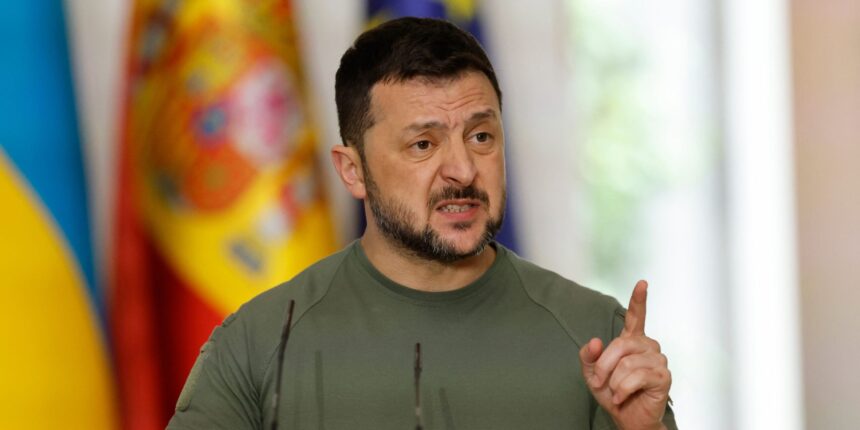
Ukrainian President Volodymyr Zelensky reaffirmed that Ukraine will neither de jure nor de facto recognize the Donbas region occupied by Russian forces as part of Russia, amid ongoing discussions on ending the war.
The remarks came following two days of high-level talks in Berlin between U.S., German, and Ukrainian officials, which focused on providing security guarantees for Kyiv and exploring a diplomatic resolution to Russia’s nearly four-year invasion.
“We are discussing territorial issues, which remain one of the key points. There is still no consensus on this matter,” Zelensky told journalists.
Security Guarantees and NATO-Style Protection
U.S. negotiators reportedly offered security guarantees similar to NATO’s collective defense, which Ukrainian officials insist must be legally binding and approved by the U.S. Congress, including provisions akin to Article 5 of the NATO treaty, which treats an attack on one member as an attack on all.
Zelensky emphasized that these guarantees are critical for Ukraine, warning that without them, any peace agreement could leave the country vulnerable to future Russian aggression.
The discussions also recalled the 1994 Budapest Memorandum, under which Ukraine, Belarus, and Kazakhstan gave up Soviet-era nuclear arsenals in exchange for security assurances from Russia, the United States, and the United Kingdom. The memorandum prohibited threats or the use of force against these states except in self-defense or under UN Charter provisions.
Russian Response
Russian officials have remained cautious and non-committal. Kremlin spokesperson Dmitry Peskov stated that Moscow had not reviewed the proposals discussed in Berlin or the U.S. security offer. Peskov reiterated that Russia is not seeking a temporary ceasefire, such as the one proposed for Christmas, but a final peace settlement that meets Russia’s objectives.
Deputy Foreign Minister Sergei Ryabkov added that while a deal may be near, Russia has not changed its stance on territorial issues, including its demand that four partially occupied Ukrainian regions—Luhansk, Donetsk, Zaporizhzhia, and Kherson—be recognized as Russian. The annexation of Crimea in 2014 continues to be rejected by almost all countries worldwide.
Diplomatic Outlook
The Berlin talks have raised hopes for a diplomatic resolution, even as the war has killed or injured over 1.5 million people and caused widespread destruction in Ukraine. U.S. officials participating in the negotiations said the security guarantees are intended to strengthen Ukraine’s defense and deter future aggression.
Former U.S. President Donald Trump, speaking after a call with leaders involved in the Berlin discussions, said negotiators were “closer than ever” to reaching a settlement.