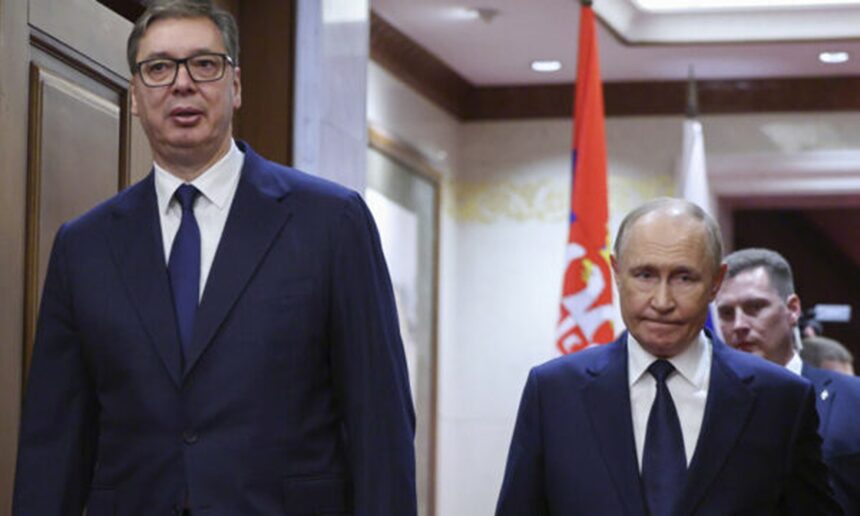
Serbian President Aleksandar Vučić has refused to attend the European Union–Western Balkans summit taking place today in Brussels, where one of the main topics is the EU’s and the region’s support and solidarity with Ukraine. Vučić’s close ties with Russian President Vladimir Putin and Serbia’s relations with Russia have been well known for years and continue to shape Belgrade’s positioning on the international stage.
The decision was made public by Vučić himself on Tuesday evening, when he announced that he would not travel to Brussels to participate either in the summit or in the intergovernmental conference held alongside it. He stressed that, for the first time in 14 years, Serbia will have no representative in this format of meetings with the European Union.
In a statement to Radio Television of Serbia (RTS), Vučić said the decision was taken, according to him, to protect Serbia’s state interests and to avoid political pressure on the Serbian government. He added that this step was intended to spare other officials from bearing responsibility that, in his view, could have negative consequences for the country.
Although he stated that Serbia formally remains committed to European integration, Vučić acknowledged that the country will not be represented at this important summit for the Western Balkans. He also said that over the past 24 hours he had held talks with several European officials and thanked European Commission President Ursula von der Leyen and European Council President António Costa for what he described as a fair approach toward Serbia.
At the conclusion of the summit, a joint EU–Western Balkans declaration is expected to be adopted, with regional partners anticipated to endorse it. According to EU announcements, leaders will also discuss foreign and security policy issues, with particular emphasis on continued support for Ukraine.
“EU and Western Balkans leaders are united in their unwavering support and solidarity with Ukraine,” the European Union said in its official statement.
The EU also reiterated the importance of aligning Western Balkan countries with the Common Foreign and Security Policy. In this regard, Serbia continues to lag behind due to its relations with Russia and its refusal to impose sanctions on Moscow over the war in Ukraine. The European Union has praised those countries in the region that are already fully aligned with this policy and has encouraged others, including Serbia, to take concrete steps in that direction.