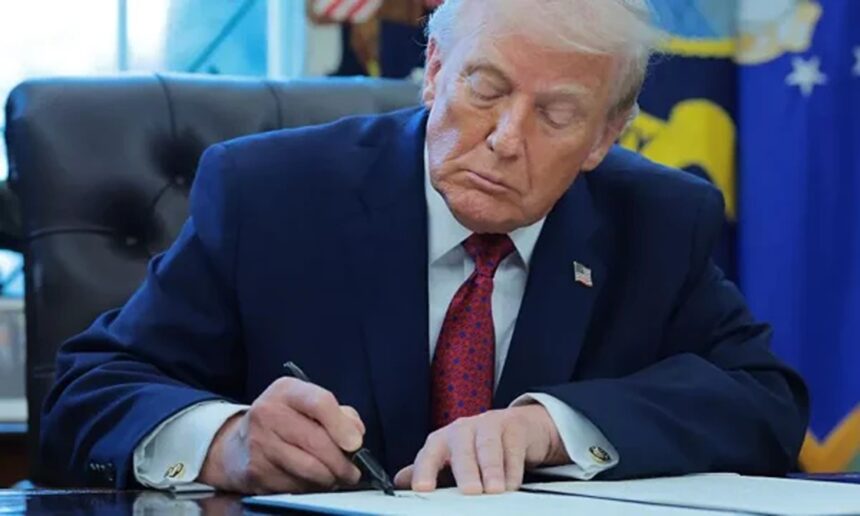
Venezuela has strongly condemned an order by U.S. President Donald Trump to impose a “total and complete” blockade on sanctioned oil tankers entering or leaving Venezuelan ports, describing the move as a dangerous, warmongering threat, according to reports by the BBC.
Trump announced the decision after declaring that the government of President Nicolás Maduro had been designated a Foreign Terrorist Organization (FTO), accusing it of involvement in drug trafficking and human smuggling.
The escalation follows the seizure of an oil tanker near Venezuela’s coast last week, a significant move given the country’s heavy dependence on oil exports. The United States has also carried out deadly strikes on vessels suspected of drug trafficking and has significantly increased its naval presence in the region.
In response, the Venezuelan government accused Washington of attempting to steal its natural resources and violating international law.
In a post on Truth Social, Trump claimed that Venezuela was now “completely surrounded by the largest armada ever assembled in the history of South America,” adding that the U.S. military presence would “only grow larger” and be unlike anything the region had seen before.
Trump further accused the Maduro government of using “stolen oil” to finance itself, drug terrorism, human trafficking, murder, and kidnapping.
Since September, the U.S. military has reported killing at least 90 people in operations targeting vessels suspected of transporting fentanyl and other illegal drugs toward the United States. However, no public evidence has been provided confirming that these vessels carried fentanyl or cocaine.
Trump suggested that the FTO designation, previously applied to specific individuals, now extends to the entire Venezuelan government. Last month, the U.S. designated the Cartel de los Soles as an FTO — a move that effectively labeled Maduro himself as a terrorist, an accusation he firmly denies.
The U.S. president’s statement did not clarify how the oil tanker blockade would be enforced. Following last week’s seizure, Washington imposed new sanctions on six additional vessels, as well as on relatives of President Maduro and businesses linked to his administration.
Despite holding the world’s largest proven oil reserves, Venezuela’s economy remains fragile, with oil production significantly below capacity.
The White House said the seized tanker, Skipper, was involved in “illegal oil transportation” and would be taken to a U.S. port. Caracas rejected the claim, with Maduro stating that the U.S. had “kidnapped the crew” and “stolen the vessel.”
U.S. military deployments in the Caribbean Sea have intensified in recent months, involving thousands of troops and the deployment of the USS Gerald Ford, the world’s largest aircraft carrier, positioned within striking distance of Venezuela.
U.S. Democratic Congressman Joaquin Castro of Texas described Trump’s naval blockade as “clearly an act of war”, announcing that lawmakers would introduce a resolution seeking to halt hostilities against Venezuela.
Both the Trump administration and former President Joe Biden have maintained a hard line against Maduro’s government for years, imposing severe sanctions and calling for his removal. The Venezuelan government has faced widespread international criticism over human rights abuses and disputed elections, allegations it denies.
On Tuesday, UN High Commissioner for Human Rights Volker Türk warned that “the shrinking of civic space has intensified, suffocating people’s freedoms” in Venezuela.