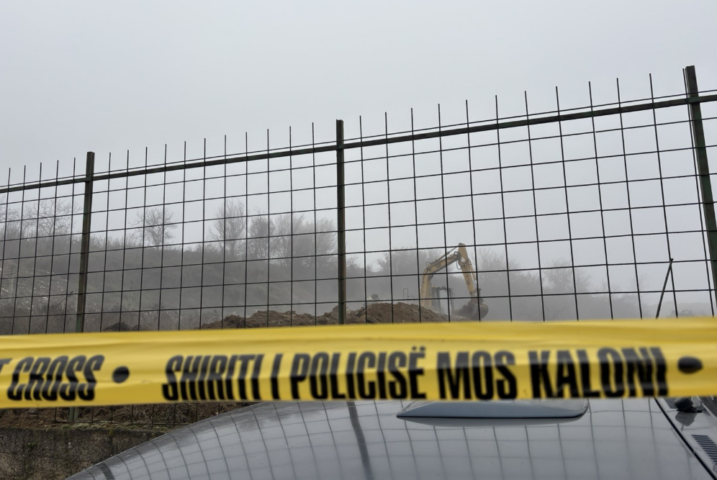
The remains of at least two individuals believed to be missing from the 1998–1999 Kosovo war have been discovered in Rahovec, as authorities conclude the final excavation operation of 2025. Officials warn that the site may contain the remains of at least eight victims, underscoring the scale of unresolved wartime crimes.
The excavation site, located three kilometers outside the city of Rahovec, was examined over three days. According to forensic anthropologist Ditor Haliti, skeletal remains recovered on December 18 and 19 have been transferred to the Institute of Forensic Medicine (IML) for autopsy, DNA sampling, and identification.
“So far, we have recovered the remains of two individuals, along with additional bone fragments that are still being assessed for medico-legal relevance,” Haliti stated.
Evidence of Concealed War Crimes
Kushtrim Gara, representing the Government Commission on Missing Persons, said the findings are linked to the summer of 1998, when Serbian forces allegedly buried more than 40 victims at the site in an attempt to conceal war crimes.
“This was part of a systematic effort to hide crimes of genocidal proportions,” Gara said.
The location had previously been examined shortly after the war by German forensic teams working with The Hague Tribunal, but new information prompted renewed excavation in 2025 following a report by Kosovo Police investigators to the Special Prosecution.
Witness Accounts Describe Brutal Treatment of Victims
A former member of the Kosovo Liberation Army (KLA), Qemajl Krasniqi, described the inhumane handling of bodies following massacres in Rahovec.
“The bodies were transported in trucks and dumped in the most degrading manner possible. This site was once used for animal waste, and the victims were deliberately desecrated,” he said.
Ongoing Search for the Missing
During 2025, excavations were conducted at 32 locations across Kosovo, resulting in the discovery of 22 sets of human remains, according to the Special Prosecution of Kosovo.
Prosecutor Armend Zenelaj reaffirmed institutional commitment to justice:
“Resolving the fate of missing persons remains a priority, and this work will continue into next year,” he said.
Police investigator Florim Elshani emphasized the importance of public cooperation, noting that citizen information remains crucial in identifying new locations for excavation.
Serbia Criticized for Lack of Cooperation
Andin Hoti, head of the Government Commission on Missing Persons, said Kosovo continues its efforts despite Serbia’s refusal to open wartime archives or fully cooperate.
“Kosovo has a moral obligation to find the more than 1,500 people still missing. No blockade will stop this process,” Hoti stated.
Currently, 1,577 people remain missing from the Kosovo war.
Families Demand Justice After 26 Years
Families of the missing say every discovery brings both hope and renewed pain.
“We have lived with this suffering for 26 years. Any news reopens old wounds, but we will not stop seeking the truth,” said Selami Hoti, a representative of families from Krusha e Madhe.
Legacy of Mass Graves
The largest mass grave linked to the Kosovo war was discovered in Batajnica near Belgrade, where over 700 bodies were exhumed between 2001 and 2002. Additional mass graves were found in Petrovo Selo, Kizhevak, and Perućac.
The 1998–1999 war in Kosovo resulted in:
- Over 13,000 deaths
- More than 20,000 women subjected to sexual violence
- Nearly one million ethnic Albanians forcibly displaced