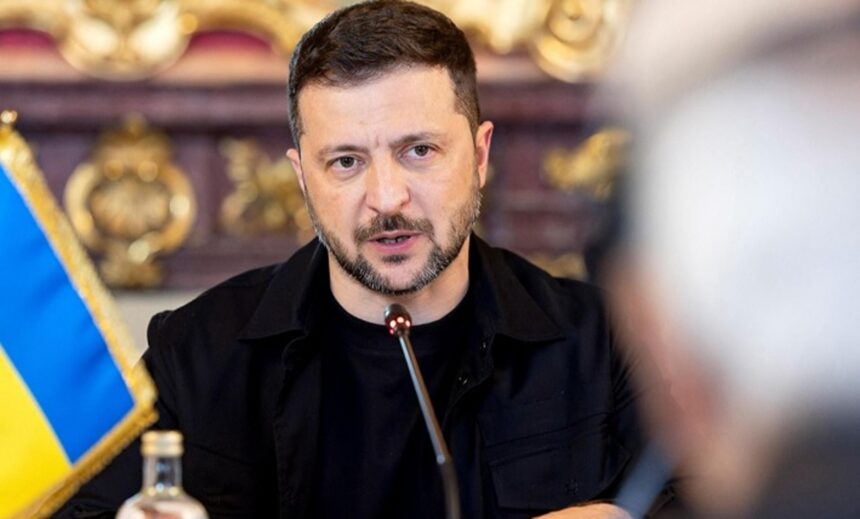
For the first time since the start of negotiations, Ukrainian President Volodymyr Zelensky has publicly released all 20 points of Ukraine’s peace plan, shedding light on a document aimed not only at ending the war but also at reshaping Europe’s future security architecture.
The disclosure was made during a meeting with journalists and reported by RBC-Ukraine.
At the core of the plan lies a non-negotiable red line: Ukraine’s sovereignty.
“This is not subject to discussion,” Zelensky stressed, positioning sovereignty as the political backbone of the entire document. From this principle flows the broader security framework Ukraine and its Western allies seek to establish once the war ends.
Security Guarantees and Military Posture
The plan envisions a non-aggression pact with Russia, accompanied by monitoring mechanisms along the front line. However, the central issue remains security guarantees, which Zelensky describes as the plan’s most critical element.
Under the proposal, the United States, NATO, and European countries would provide Ukraine with guarantees similar to NATO’s Article 5: any renewed Russian aggression would trigger military responses and the reimposition of sanctions.
Ukraine rejects demilitarization, maintaining armed forces of up to 800,000 troops even in peacetime. Russia, for its part, would be legally bound to a policy of non-aggression toward both Ukraine and Europe.
European Integration and Reconstruction
The European dimension is equally explicit. Ukraine’s EU membership must include a fixed date, not an open-ended promise. The plan also outlines a global development strategy, supported by an investment agreement and an $800 billion reconstruction fund to revive Ukraine’s war-ravaged economy.
Relations with the United States receive special emphasis through a fast-tracked free trade agreement, while Ukraine reaffirms its non-nuclear status as a pillar of regional stability.
Red Lines and Territorial Challenges
Another firm red line concerns the Zaporizhzhia Nuclear Power Plant, where Zelensky insists no compromise is possible. The U.S. has proposed a tripartite administration, while Ukraine suggests a 50–50 management model with the United States.
Territorial issues remain the most complex. One option foresees Russia’s withdrawal from Dnipropetrovsk, Mykolaiv, Sumy, and Kharkiv, while a “freeze at current positions” is proposed for Donetsk, Luhansk, Zaporizhzhia, and Kherson. Russia demands Ukraine’s withdrawal from Donetsk, whereas the U.S. has floated the idea of a free economic zone as a compromise. Failing agreement, the issue could be put to a referendum, alongside the full peace document.
Additional Provisions
The plan also includes:
- Commitments by both sides not to alter the agreement by force
- Freedom of navigation on the Dnipro River and the Black Sea
- Prisoner exchanges and the return of civilians, children, and political detainees
- National elections in Ukraine immediately after the agreement is signed
- Legal oversight by a Peace Council led by Donald Trump
- A full and immediate ceasefire once all parties agree
The full publication of these 20 points shifts the debate from general statements to concrete details, making clear that peace is possible, but fraught with deep political, territorial, and geostrategic dilemmas.