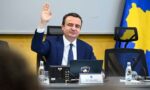
Serbian President Aleksandar Vučić has once again openly interfered in Kosovo’s internal democratic process, publicly urging Kosovo Serbs to support the Serb List, a party widely viewed as operating under direct influence from Belgrade.
Speaking to the media, Vučić claimed that Serbs in Kosovo must secure political representation that would, in his words, “defend Serbian national interests rather than those of Kosovo Prime Minister Albin Kurti.” His remarks come just days before Kosovo’s parliamentary elections, raising serious concerns about external political pressure and electoral interference.
Direct Endorsement and Political Pressure
Vučić praised the decision of candidate Nikolićević from Shtërpca to withdraw from a rival list, which he labeled as being close to Kurti. He described the move as a “positive message,” while dismissively referring to the list as “Kurti’s list, or more precisely, Rashić’s list.”
In a clear and unambiguous endorsement, Vučić stated that he expects the Serb List to win and secure the highest number of seats reserved for the Serbian community in Kosovo’s Assembly.
“I sincerely support the Serb List and hope for a large and meaningful victory,” Vučić said, adding that he wants Serb representatives to serve Belgrade’s interpretation of Serbian interests—not the institutions of Kosovo.
Undermining Kosovo’s Sovereignty
Political analysts view Vučić’s statements as a direct challenge to Kosovo’s sovereignty, reinforcing long-standing accusations that Serbia treats the Serb List as a political extension of its own government, rather than as an independent representative of Kosovo Serbs.
Such interventions contradict democratic norms and international standards, particularly when coming from a foreign head of state during an active election campaign in another country.
Selective Attention and Political Calculations
Vučić also admitted that he has not closely followed political developments or polling data from Prishtina in recent days, stating that he hopes to focus on them later. Critics argue that this remark further highlights his opportunistic and instrumental approach to Kosovo, engaging only when it suits Belgrade’s political agenda.
This latest episode adds to a growing pattern of interference, where Vučić seeks to maintain control over Serb political representation in Kosovo, while publicly denying responsibility for rising tensions and democratic erosion in the region.