If a referendum on Serbia’s membership in the European Union were held next week, the pro-accession option would narrowly prevail, according to a public opinion survey conducted this month. However, the long-term trend of declining EU support in Serbia continues.
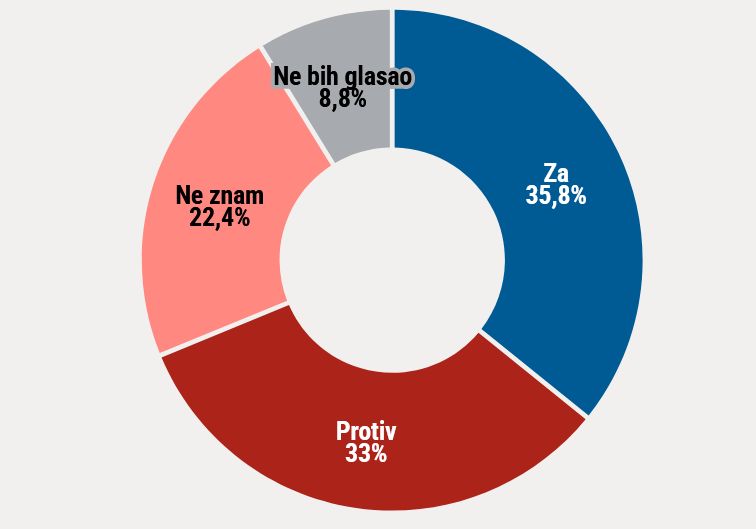
According to the survey commissioned by the Center for Contemporary Politics, 35.8% of respondents would vote in favor of EU membership, 33% would vote against, 22.4% are undecided, and 8.8% say they would not vote.
Generational Differences:
Support for EU membership is strongest among citizens under 50, while opposition dominates among older age groups. The youngest respondents (18–29 years old) show the lowest level of opposition at 18.7%, while support reaches 41.9%. Among the oldest respondents (over 70 years old), support falls to 20.5%. Young people also make up the largest share of undecided voters, at nearly one-third.
Expert Commentary:
Bojana Selaković, coordinator of the National Convention on the EU (NKEU), emphasizes that these findings contradict the perception that young Serbians are anti-European. She notes that younger generations view the EU as a practical instrument for life opportunities—mobility, border-free travel, education, labor market access, and legal security—but may not fully recognize that these benefits result from European integration.
Srđan Majstorović, president of the Board of Directors of the Center for European Policies (CEP), highlights that support among young people aligns with their demand for change in the state and society. He stresses that government narratives portraying youth as anti-European are empirically refuted by these results.
Reasons for Declining Support:
- Government campaigns have systematically undermined the EU’s image while benefiting from EU grants exceeding €200 million annually.
- Media control and fear-based narratives have fueled public skepticism toward Europe and the West.
- EU missteps, including a lack of clear support for the democratic movement during recent protests, have weakened its credibility in Serbia.
Bojana Selaković notes that the fact that one-fifth of citizens are undecided reflects a deep information gap, caused by contradictory political and media messages portraying the EU simultaneously as a goal and a problem. She concludes that the European idea in Serbia is not defeated but politically neglected, lacking leadership and clear, credible content.