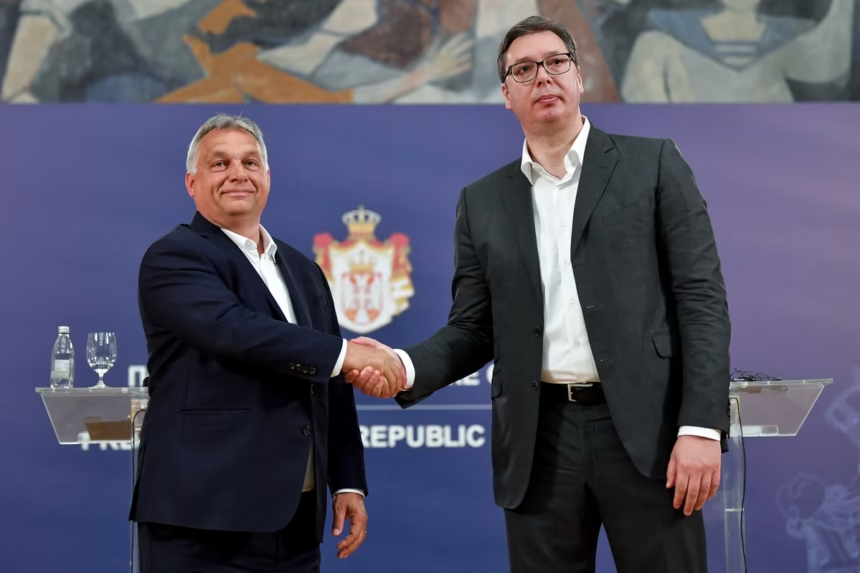
Serbian President Aleksandar Vučić held separate talks with Hungarian Prime Minister Viktor Orbán and Russian Ambassador Aleksandr Bocan-Harčenko, with energy security dominating both discussions, according to official statements released on Saturday.
In his phone call with Orbán, Vučić said they discussed the current state of energy security and “next steps” aimed at stabilizing energy supplies, as well as plans to develop regional infrastructure for energy transport, storage, and distribution.
“We also discussed Serbia’s position on the European path and the broader geopolitical situation, with particular attention to relations between Ukraine, Russia, and the EU,” Vučić wrote on Instagram, thanking Hungary and Orbán for being what he described as a “reliable partner in difficult times.”
Parallel Messaging to Moscow
On the same day, Vučić met with Russian Ambassador Aleksandr Bocan-Harčenko, again focusing on energy security, with particular emphasis on the impact of U.S. sanctions and what Vučić called “possible solutions.”
Vučić reiterated that Serbia remains committed to dialogue and cooperation with all partners, claiming the government would protect the country’s “vital national interests.”
Critical Context: Strategic Ambiguity and Political Dependence
While officially framed as pragmatic diplomacy, these parallel engagements once again underline the Vučić government’s long-standing strategy of geopolitical balancing, which critics argue has turned into strategic ambiguity that weakens Serbia’s credibility.
At a time when the EU expects clear alignment with its foreign and sanctions policy, Vučić continues to publicly emphasize close ties with both Moscow and Budapest, two actors increasingly at odds with mainstream EU policy. This approach has raised concerns that energy policy is being instrumentalized for political survival, rather than shaped through transparent, long-term planning.
NIS Sale Raises Transparency Concerns
The talks come amid confirmed negotiations over the possible sale of the Russian-owned stake in Serbia’s oil company NIS, potentially to Hungary’s MOL. Energy experts and opposition figures warn that:
- Key strategic decisions are being made behind closed doors
- Serbia risks losing control over critical infrastructure
- The government is prioritizing short-term political stability over long-term national interest
Critics argue that Vučić’s insistence on “protecting national interests” contrasts sharply with a lack of parliamentary debate, public transparency, and independent oversight in major energy decisions.
Broader Implications
The latest diplomatic moves reinforce concerns that Serbia’s energy dependence—particularly on Russian resources—continues to be used as leverage, both externally and domestically. Analysts warn that this perpetuates Serbia’s vulnerability, delays EU integration, and cements an opaque, personalized decision-making system centered around the president.