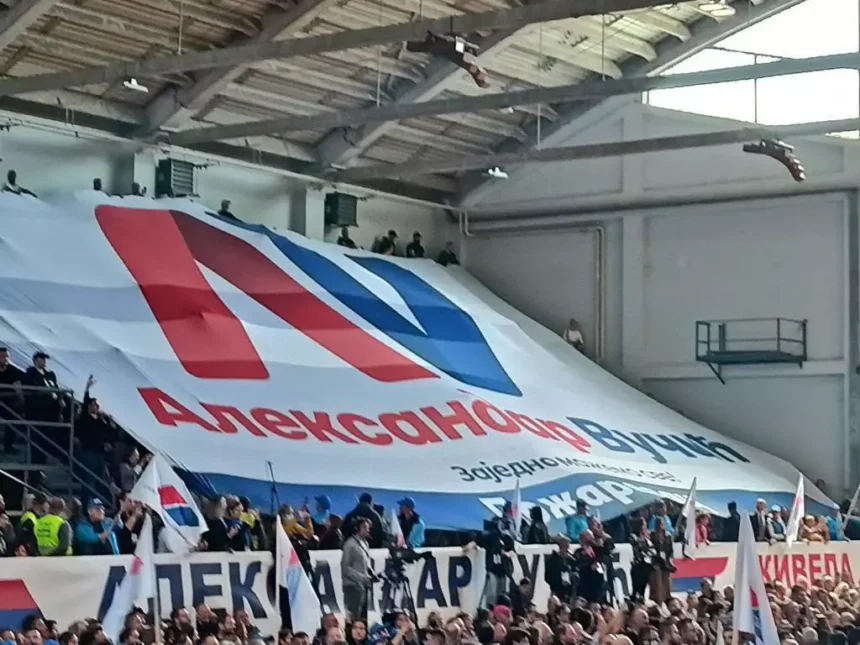
According to a new analysis by Demostat, loyalty — rather than performance, accountability, or policy results — is the defining identity marker of supporters of Serbian President Aleksandar Vučić and the ruling Serbian Progressive Party (SNS).
Researcher Srećko Mihailović argues that Vučić’s most committed supporters are bound not by rational evaluation, but by uncritical devotion and political obedience, often detached from any objective assessment of the regime’s actions or failures.
Loyalty Over Reality
Demostat notes that SNS loyalists are “far removed from any objective evaluation of the ‘deeds and misdeeds’ of their leader”, operating within a closed political universe where criticism of Vučić is treated as hostility.
While loyalty unites them and separates them from the broader public critical of the regime, Mihailović identifies two main categories:
1. “Sincere” Loyalists – Ideological Followers
These supporters display voluntary and emotional loyalty, divided into three subgroups:
- Cheerleader-subjects, who act as political fans rather than citizens
- Leader-worshippers, who elevate Vučić into a near-mythical figure
- Participants in the delusion of national grandeur, who believe in a narrative of Serbia’s “sacred power pyramid” built around a single leader
This group illustrates how personality cult dynamics have replaced democratic political culture in Serbia.
2. Interest-Based Loyalists – Loyalty for Personal Gain
The second group consists of interest-driven loyalists, who support the regime primarily for material benefits, career advancement, protection, or survival within a clientelist system.
Their loyalty is described as partly voluntary and partly coerced, reflecting a system where political allegiance is often required to secure employment, contracts, or institutional protection — a hallmark of state capture.
How Large Is Vučić’s Hard Core?
Demostat’s long-term research shows that around 20% of respondents openly admit a positive attitude toward SNS and feel comfortable expressing it publicly.
Given Serbia’s electorate of roughly five million voters, this translates to about one million SNS supporters.
Of those, Demostat estimates that roughly three-quarters — around 750,000 people — form Vučić’s hard core, a bloc defined by loyalty rather than democratic accountability.
What This Means for Serbian Democracy
The findings underline a troubling reality: Vučić’s rule rests less on broad public consensus and more on a tightly bound network of ideological followers and interest-dependent loyalists, sustained by media control, pressure on institutions, and a pervasive system of rewards and punishments.
This structure helps explain why electoral processes, institutions, and public debate in Serbia remain deeply distorted, and why genuine political competition faces systematic obstacles.