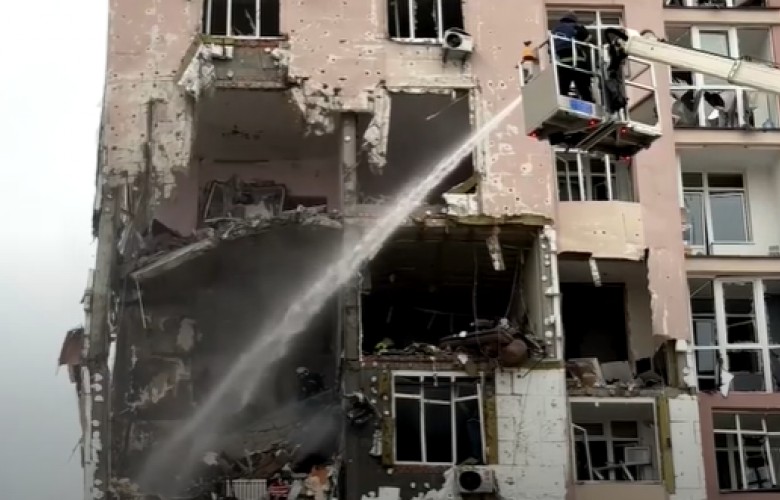
Russia launched a massive overnight assault on Kyiv and other parts of Ukraine, deploying hundreds of drones and dozens of missiles just days before what Ukrainian President Volodymyr Zelensky described as a decisive meeting with U.S. President Donald Trump aimed at finding a path to end nearly four years of war.
Zelensky said the attack involved around 500 drones and 40 missiles, causing power and heating outages across parts of the capital. He described the strikes as Russia’s response to ongoing U.S.-mediated peace efforts.
The Sunday meeting in Florida is expected to focus on security guarantees and territorial control once the war ends, in what remains Europe’s deadliest conflict since World War II, following Russia’s full-scale invasion in 2022.
Civilian Impact and Casualties
Air raid sirens sounded in Kyiv for nearly 10 hours, as Ukrainian air defense units intercepted incoming threats. Authorities confirmed two fatalities in Kyiv and the surrounding region, with at least 46 people injured, including two children.
Ukraine’s state power grid operator Ukrenergo reported strikes on energy facilities nationwide, triggering emergency power outages. The private energy provider DTEK said more than one million homes in and around Kyiv lost electricity, with 750,000 still without power by midday.
Deputy Prime Minister Oleksiy Kuleba stated that over 40% of residential buildings in Kyiv were left without heating, as temperatures hovered around 0°C (32°F).
“This is how Russia responds to peace negotiations between Ukraine and the United States,” Zelensky said, condemning the attacks.
International Reactions and Diplomatic Efforts
While traveling to meet Trump, Zelensky stopped in Halifax, Canada, to meet Prime Minister Mark Carney, who announced CAD 2.5 billion (USD 1.83 billion) in additional economic aid for Ukraine.
“Peace requires a willing Russia,” Carney said, adding that the overnight bombardment of Kyiv underscored the urgency of standing with Ukraine.
Zelensky later spoke with European leaders, with European Commission President Ursula von der Leyen reaffirming support for a just and lasting peace that preserves Ukraine’s sovereignty and territorial integrity.
Territorial Disputes and Stalled Negotiations
Territorial control and the future of the Russian-occupied Zaporizhzhia nuclear power plant remain major diplomatic obstacles. Zelensky confirmed that a 20-point draft peace framework, forming the basis of a U.S.-led initiative, is 90% complete.
He emphasized that U.S. security guarantees would be decisive and depend on Trump’s willingness, timing, and long-term commitment. According to Axios, Washington has proposed a 15-year security guarantee, while Kyiv is pushing for longer, legally binding protections.
Trump stated that the United States is leading the peace process, saying, “Nothing happens without my approval.” He expressed confidence that the upcoming meeting would be productive and said he expects to speak with Russian President Vladimir Putin soon.
Donetsk and the Frontline Reality
Moscow continues to demand that Ukraine withdraw from densely populated areas of the eastern Donetsk region, while Kyiv insists fighting should stop along current front lines. Russia has made slow territorial gains in 2025, suffering heavy losses in drone-intensive combat.
Both sides issued conflicting claims over frontline towns in eastern and southern Ukraine, reflecting the ongoing volatility.
Under a proposed U.S. compromise, an economic free zone could be established if Ukrainian forces withdraw from parts of Donetsk, though details remain unresolved.
Zelensky said that if U.S. backing on territorial issues cannot be secured, he would consider putting the peace plan to a referendum, provided Russia agrees to a 60-day ceasefire. However, he stressed that holding a referendum while cities are under bombardment is impossible.
Russian Deputy Foreign Minister Sergei Ryabkov acknowledged differences between the Ukrainian and Russian versions of the plan but suggested talks had reached a “turning point”.