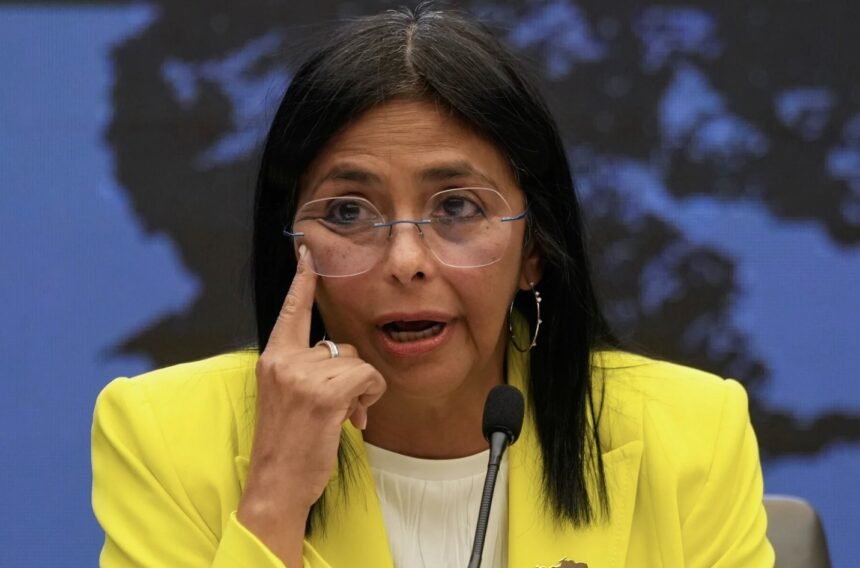
Following the U.S. operation over the weekend that captured Venezuelan President Nicolás Maduro and transported him to New York for trial, Delcy Rodríguez, Venezuela’s vice president, has assumed temporary leadership of the country, a move long anticipated by U.S. officials.
Rodríguez, a seasoned political operator with strong ties to Venezuela’s oil industry, was part of secret negotiations last year led by her brother, Jorge Rodríguez, with Washington regarding a potential post-Maduro transition. Plans included a secure exile for Maduro, though these negotiations ultimately did not materialize.
An investor in Venezuela told the Financial Times that the Trump administration had been “building the transition around Delcy for some time,” recognizing her as a pragmatic and constructive figure rather than a mere figurehead in dealings with the U.S.
Balancing Domestic and International Pressures
At 56, Rodríguez faces a delicate balancing act: maintaining support among domestic audiences while navigating both praise and threats from Washington. President Trump warned that if the new Venezuelan leadership does not act appropriately, a second intervention could occur, potentially putting Rodríguez in a situation “worse than Maduro.”
Despite assuming authority, Rodríguez emphasized her loyalty to Maduro in a cabinet meeting, stating, “There is only one president in this country, and his name is Nicolás Maduro.” The Venezuelan Supreme Court granted her temporary presidential powers.
Secretary of State Marco Rubio noted that U.S. officials are evaluating the situation based on actions rather than public statements, stressing that Rodríguez’s domestic messaging is aimed at consolidating power within Venezuela.
Political and Economic Credentials
Born in Caracas in 1969 to a Marxist guerrilla father, Rodríguez has a reputation as a shrewd political operator and pragmatic problem solver. She rose in prominence under Maduro, supported by her brother Jorge, who is the head of the National Assembly and Maduro’s chief political adviser.
Rodríguez has served as Foreign Minister (2014) and Minister of Finance and Energy (2020), overseeing Venezuela’s critical oil industry. Her pragmatism impressed U.S. and international energy firms, including Chevron, facilitating limited operations despite sanctions.
Despite sanctions from the U.S., Canada, and the EU for undermining democracy and the rule of law, Rodríguez’s technical knowledge and negotiation skills positioned her as a viable face of a transitional administration acceptable to Washington.
Strategic Considerations for the U.S.
The Trump administration’s support for Rodríguez reflects a pragmatic approach, prioritizing immediate stability and the reactivation of Venezuela’s oil production over backing opposition figures such as María Corina Machado or Edmundo González, who lack credibility with security forces.
Experts suggest that Rodríguez’s reliance on her brother and the civil wing of the chavista movement necessitates forming alliances with military leaders such as Vladimir Padrino López and Diosdado Cabello to consolidate power.
Vanessa Neumann, a former opposition envoy with close ties to U.S. security circles, warned that Rodríguez faces a complex geopolitical tango: “Delcy will navigate the Trump team, face potential backstabbing from Diosdado and Padrino López, and then risk kinetic intervention from Washington.”
Rodríguez’s rise marks a critical turning point in Venezuela’s political landscape, blending domestic loyalty, oil industry expertise, and U.S. strategic interests into a high-stakes transitional leadership.