While Serbian authorities portray the country as an “economic tiger” enjoying its best year in history, international economists and financial analysts paint a far more troubling picture of Serbia’s economic reality.
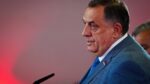
President Aleksandar Vučić has repeatedly claimed that Serbia is experiencing a “golden age”, highlighted by record pension increases and promises of peace, stability, and historic economic growth. These messages are often reinforced through charts, public presentations, and optimistic rhetoric aimed at reassuring citizens.
However, leading global economic assessments sharply contradict this narrative.
Global Analysts See Slowing Growth and Rising Pressure
According to Germany’s Frankfurter Allgemeine Zeitung (FAZ), Serbia’s economic growth in 2025 was cut in half, while foreign direct investment declined significantly and domestic consumption weakened.
“According to a broad consensus among economists, Serbia’s growth slowed dramatically in 2025, foreign investments fell, domestic demand stagnated, and President Vučić is increasingly challenged by student protests,” FAZ reports.
The German newspaper also notes that Vučić is facing unprecedented political and economic pressure, despite publicly declaring 2025 to be “the best year in Serbia’s history.”
Sanctions, Energy Risks, and Delayed Admissions
Contrary to his public optimism, Vučić himself indirectly acknowledged economic difficulties, referencing sanctions on Serbia’s oil company NIS and restrictions on Chinese investor Linglong.
“We have sanctions on NIS and on the Chinese company Linglong, and we will have to fight through this,” Vučić stated — notably without providing a clear strategy for addressing the challenges.
FAZ highlights that Serbia faced nearly 100 days of uncertainty regarding oil supplies, even as officials publicly insisted that there were no fuel shortages, a claim critics argue downplays real risks.
Rising Pensions, But at What Cost?
The government has emphasized a 12% pension increase as proof of economic success. Parliament Speaker Ana Brnabić echoed this optimism, predicting a stronger 2026.
Yet, the opposition argues that citizens did not live well in 2025, and that Vučić’s priorities reveal a different agenda.
“The facts confirm that people in Serbia did not live well in 2025. Vučić’s priorities for 2026 are increased salaries for special police and military units and further arming of security forces,” said Dušan Nikezić of the Freedom and Justice Party (SSP).
Strained International Relations Add to Uncertainty
FAZ further reports that Serbia’s relations with key international partners are deteriorating:
- With the United States, over disputes related to the General Staff building
- With Russia, due to alleged Serbian ammunition exports to Ukraine
- With the European Union, as no new negotiation cluster has been opened, and Vučić skipped the EU–Western Balkans summit
The EU remains Serbia’s largest trading partner and investor, making these tensions economically significant.
Bleak Outlook for 2026
According to FAZ’s projections, the outlook for Serbia remains grim:
- Foreign investments halved
- Construction sector in decline
- Weak domestic demand
- Economic growth projected at just 2%
Despite these warnings, Vučić has dismissed criticism, stating:
“Of course, nothing is fair, and nothing will ever be fair.”
Narrative vs. Reality
While the Serbian government continues to sell optimism through carefully crafted messaging, international economic indicators suggest a country facing stagnation, mounting pressure, and growing isolation. The widening gap between official rhetoric and economic reality raises serious questions about transparency, sustainability, and the real cost of Vučić’s policies.