Serbian President Aleksandar Vučić is showing clear signs of fear and political insecurity, fully aware that Serbian society has crossed a point of no return, said Biljana Stojković, member of the Presidency of the Democratic Party and professor at the University of Belgrade, in an interview with N1.
According to Stojković, Vučić’s growing reluctance to call early elections—despite years of frequently organizing them—reveals a leader who knows he can no longer control public opinion through fear, manipulation, and media dominance.
“This is no longer the people Vučić once managed to keep in submission. Everything has changed, and he knows it,” Stojković stated.
Fear of Elections as Proof of Political Collapse
Stojković argues that Vučić’s fear of elections is the strongest evidence that Serbian society has broken free from apathy and helplessness. She emphasized that the regime’s propaganda narrative of progress has collapsed under the weight of everyday reality.
“Even regime-friendly media can no longer cover the gap between fantasy and real life,” she said, adding that fewer citizens are willing to believe the “illusion of stability” promoted by the government.
She was particularly critical of Vučić’s repeated public appearances and constant self-promotion, describing them as desperate attempts to conceal political exhaustion and loss of authority.
Students as the Catalyst of Social Awakening
A central theme of Stojković’s analysis is the decisive role of students, whom she credits with triggering a profound shift in collective consciousness.
“Students have initiated a revolution in how society understands the depth of the crisis we live in,” she said, describing the movement as the beginning of an irreversible process of social and institutional recovery.
The slogan displayed by students of the Faculty of Biology—“Without revolution, there is no evolution”—was, according to her, the most accurate summary of Serbia’s current moment.
Police Violence and Authoritarian Reflexes
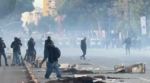
Commenting on police brutality against protesters, Stojković said such actions are typical of autocratic regimes facing imminent collapse.
“Vučić is not creative—he simply follows the handbook of every dictator,” she stated.
She stressed that violence was deliberately directed at students, a group the regime fears the most, miscalculating that repression would deter resistance rather than ignite wider public solidarity.
“When students are attacked, society responds. Parents, citizens, and entire communities stand with them,” she said.
Environmental Damage as a Symbol of Moral Decay
Stojković also addressed the environmental damage caused by prolonged encampments near state institutions, stating that Pioneer Park has effectively been turned into a landfill and will require several years to recover ecologically.
She described the scene as a metaphor for the moral and institutional degradation of the ruling elite, driven by fear rather than governance.
2026 as the Year of Resolution
Looking ahead, Stojković expressed firm belief that 2026 will mark the political end of Vučić’s rule, though she warned that escalation and repression remain real risks.
She noted systematic efforts to neutralize independent institutions, silence free media, and consolidate control over the police and judiciary—all signs of a regime preparing for confrontation rather than democratic transition.
“Vučić is terrified. All his options have collapsed, and now he is merely trying to keep himself and his supporters motivated,” she concluded.