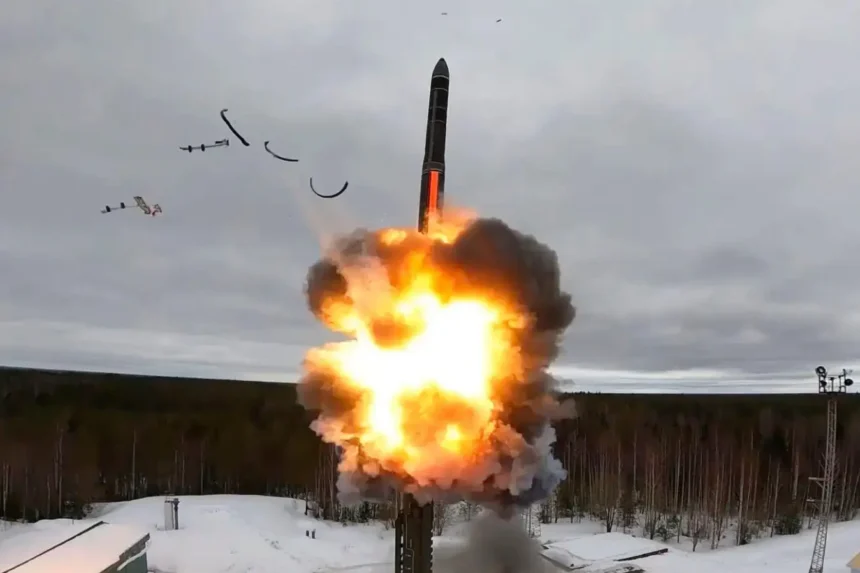
Russia launched a rare and highly significant attack on Ukraine overnight, using the Oreshnik hypersonic ballistic missile, one of the most advanced weapons in Moscow’s arsenal, amid freezing winter temperatures.
According to a statement released Friday by the Russian Ministry of Defense, the strike was part of a large-scale assault using long-range, high-precision weapons launched from both land and sea, including the mobile medium-range Oreshnik missile system.
“The Armed Forces of the Russian Federation carried out a massive strike with long-range, high-precision weapons, including the Oreshnik ground-based missile system,” the ministry said.
What Is the Oreshnik Missile?
The Oreshnik missile, whose name translates to “hazelnut tree”, is one of Russia’s newest and most formidable weapons. According to Russian missile force officials, it can travel at up to 10 times the speed of sound and has a range capable of reaching targets across Europe, CNN reported.
The missile is capable of carrying multiple warheads and can be equipped with either conventional or nuclear payloads. Russia first used the Oreshnik in November 2024, striking the Ukrainian city of Dnipro, even though the system was not yet fully operational at the time. Last month, Moscow also released footage claiming the deployment of the Oreshnik system in Belarus, a close Russian ally.
Targeted Areas and Casualties
Ukrainian authorities reported multiple explosions, including a ballistic missile strike on critical infrastructure in the western city of Lviv. Ukraine’s Air Force Command “West” stated that the missile was traveling at approximately 13,000 kilometers per hour along a ballistic trajectory, equivalent to ten times the speed of sound.
In Kyiv, CNN reporters said the attack began shortly after midnight, initially involving drone strikes on residential buildings.
According to Kyiv Mayor Vitali Klitschko, four people were killed and at least ten others injured, while critical infrastructure sustained damage. In contrast, Lviv Mayor Andriy Sadovyi said there were no reported casualties in his city, adding that civilian buildings were not affected.
Russia’s Justification and Escalating Tensions
Russia claimed the strike was launched in response to an alleged Ukrainian attempt to target the residence of President Vladimir Putin last month — a claim that emerged amid intensive U.S.-led negotiations, spearheaded by President Donald Trump and his envoys, aimed at ending the war.
However, U.S. officials said the CIA assessed that Ukraine did not target a residence used by Putin, casting doubt on Moscow’s justification.
The Oreshnik strike came just hours after Russia reiterated that any European troops deployed in Ukraine under a future peace deal would be considered “legitimate targets.” The statement followed pledges by France and the United Kingdom to send forces to Ukraine in the event of a peace agreement.
Broader Context: Energy Warfare and Maritime Escalation
Russia has intensified attacks on Ukraine’s energy infrastructure in recent weeks, using drones and missiles in a pattern seen during previous winters. These attacks have left tens of thousands without electricity or heating, amid sub-zero temperatures.
President Volodymyr Zelensky said the objective is “to create chaos and exert psychological pressure on the population.”
The escalation also coincided with a U.S. seizure of a Russian-flagged oil tanker in the Atlantic Ocean, an action Moscow condemned as a violation of international maritime law. The tanker had previously been sanctioned by Washington for transporting Iranian oil.
Russia’s transport ministry argued that “no state has the right to use force against vessels lawfully registered under another state’s jurisdiction,” citing the 1982 UN Convention on the Law of the Sea, which the U.S. has not ratified.
As of now, President Vladimir Putin has not publicly commented on the tanker seizure or the latest military developments.