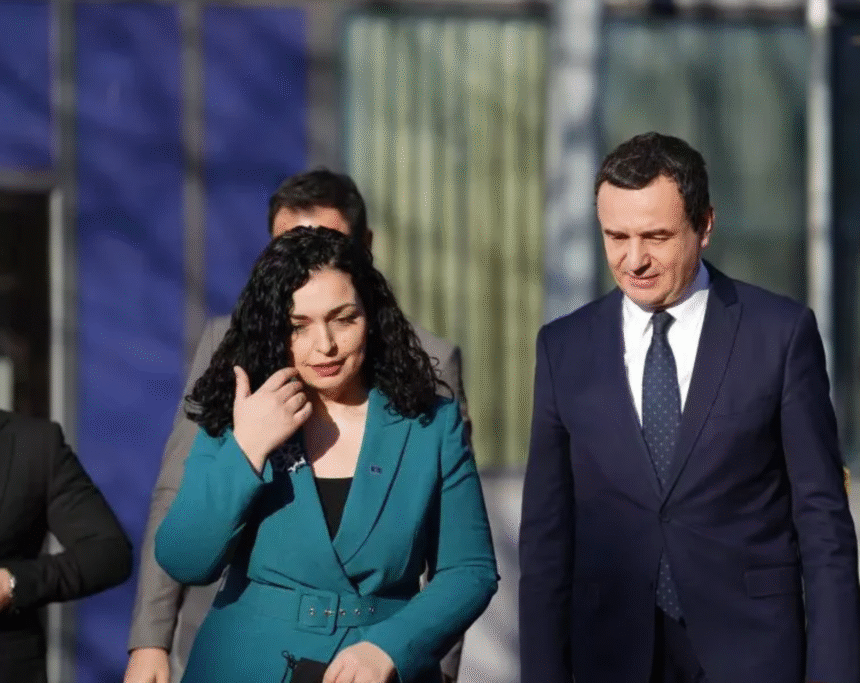
A few days after Kosovo President Vjosa Osmani expressed her ambition to run for a second five-year term, analysts say her re-election will largely depend on domestic politics.
Osmani has played a key role in representing Kosovo internationally, but her continued presidency will hinge on political calculations, particularly the support of Lëvizja Vetëvendosje (LVV) leader and outgoing Prime Minister Albin Kurti.
Her current term ends on April 4, 2026, and according to the Kosovo Constitution, a new president must be elected at least 30 days prior, meaning by March 4, 2026.
Expert Opinions
- Mazllum Baraliu, university professor, emphasizes Osmani’s international achievements, including securing four new recognitions for Kosovo last year. He believes her experience and successful foreign representation make her deserving of a second term.
- Dorajet Imeri, political analyst, notes that her re-election depends primarily on LVV and Albin Kurti, whose party won 57 seats in the December 28 elections. Domestic political dynamics, more than performance alone, will shape the outcome.
Baraliu adds:
“Osmani has represented Kosovo abroad with distinction, meeting key international leaders and strengthening the country’s foreign policy. Supporting her for a second term would be in Kosovo’s best interest.”
Meanwhile, Prime Minister Albin Kurti stressed that before discussing Osmani’s second term, three key steps must occur: forming the new Parliament and government, and approving the budget. Only after these steps can talks on the presidency progress.
Parliamentary Math
- Two rounds of voting in Parliament require 80 votes for election.
- In a third round, a president can be elected with 61 votes; otherwise, early elections will be triggered.
Based on preliminary results of the December 28 elections:
- LVV: 51.11% → 57 MPs
- PDK: 20.19% → 22 MPs
- LDK: 13.23% → 15 MPs
- AAK: 5.50% → 6 MPs
- Non-majority communities: 20 MPs
The balance of power in Parliament will be crucial in determining whether Osmani secures a second term.