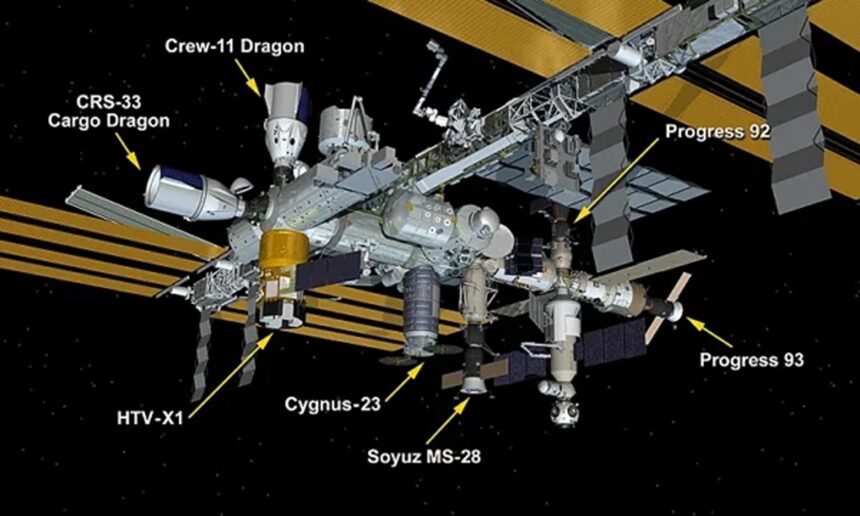
NASA and SpaceX have announced a detailed plan for an early emergency return of astronauts from the International Space Station (ISS), marking the first time in the station’s 25-year history that a mission has been shortened due to a medical incident in orbit.
On January 8, NASA confirmed its decision to bring the SpaceX Crew-11 mission back to Earth earlier than planned, after flight teams began monitoring a medical issue involving one crew member currently living and working aboard the ISS. The astronaut is reported to be in stable condition, though NASA declined to provide further details, citing medical privacy concerns.
Astronauts Zena Cardman and Mike Fincke (NASA), Kimiya Yui of the Japan Aerospace Exploration Agency (JAXA), and Oleg Platonov of Russia’s Roscosmos are scheduled to undock from the ISS on January 14, with a splashdown off the coast of California expected at approximately 3:40 a.m. Eastern Time on Thursday, January 15.
Originally, the Crew-11 astronauts were expected to remain aboard the station for another month.
NASA officials said mission managers are closely monitoring recovery zone conditions, noting that the final decision on undocking and landing depends on several factors, including spacecraft readiness, recovery team availability, weather conditions, and sea state. A precise landing site and time will be confirmed closer to departure.
The agency emphasized the historic nature of the decision, as this is the first medical-related early return from the ISS since its launch in 1998.
Following Crew-11’s early departure, NASA will maintain a reduced American presence aboard the ISS. Flight engineer Chris Williams, who arrived on the station aboard a Russian Soyuz spacecraft on November 27, will remain on orbit for several weeks to oversee U.S. scientific experiments and operational activities.
He will be joined by Russian cosmonauts Sergey Kud-Sverchkov and Sergey Mikhayev.
NASA confirmed that the next crew rotation mission is scheduled to launch in mid-February, ensuring continuity of operations aboard the orbital laboratory.
The decision underscores the agency’s priority on astronaut health and safety, while highlighting the flexibility of international partnerships and commercial spacecraft in responding to unexpected emergencies in space.