The European Union’s Special Representative for the Kosovo–Serbia dialogue, Peter Sorensen, has acknowledged that 2025 was a “difficult year” for the normalization process, expressing hope that 2026 will deliver results that failed to materialize last year.
The Danish diplomat completed his initial mandate without achieving tangible breakthroughs in EU-mediated talks — a situation he stressed was not due to a lack of engagement, but rather to political instability in both Kosovo and Serbia. Sorensen assumed his role in February 2025, coinciding with inconclusive elections in Kosovo that delayed the formation of institutions, while Serbia experienced widespread protests throughout the year.
Following the extension of his mandate by two additional years, Sorensen began 2026 with an official visit to Kosovo, where he met with caretaker Prime Minister Albin Kurti and President Vjosa Osmani.
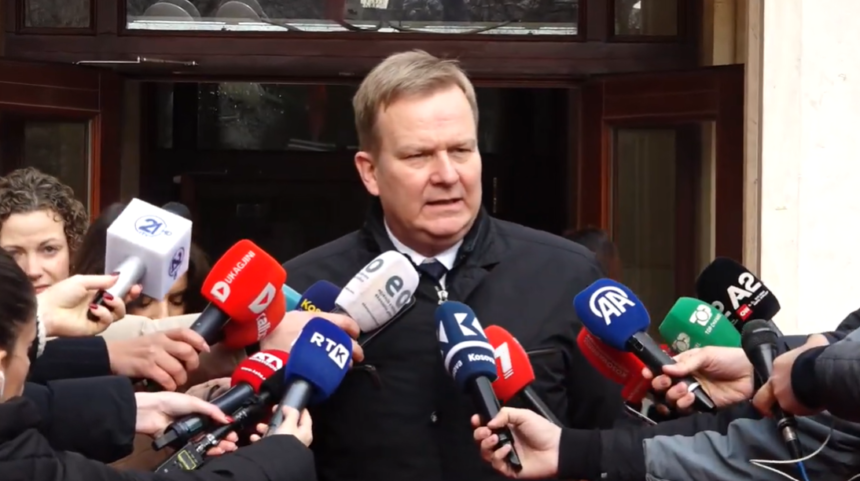
Speaking briefly to reporters outside the Presidency in Prishtina, Sorensen conveyed cautious optimism.
“I have strong hope, personally, that 2026 will bring what 2025 did not,” Sorensen said. “That is why I am starting the working year with a visit here, followed by Belgrade later this week.”
The last high-level dialogue meeting between Kosovo and Serbia was mediated by former EU foreign policy chief Josep Borrell, prior to the Banjska attack, which further stalled the process. Since then, EU High Representative Kaja Kallas has not convened a new top-level meeting, citing the absence of a fully mandated government in Kosovo and ongoing political turbulence in Serbia.
Sorensen, however, pledged that a high-level meeting will be organized when conditions allow, emphasizing that both parties would attend once invited.
“Our role is what the international community has asked of us — to facilitate dialogue and ensure both sides sit at the table,” he said. “The High Representative will call the meeting when the time is right. The parties will come, and we will see.”
His remarks came in response to questions regarding conditions set by Kosovo for returning to dialogue.
Expectations for renewed engagement have grown following the lifting of EU punitive measures against Kosovo, after the peaceful transfer of authority in four northern municipalities, and amid Brussels’ renewed focus on the Western Balkans.
Both Sorensen and Kallas are under increasing pressure to revive a dialogue process that has faced sustained criticism. Central to their mandate is the implementation of the Ohrid Agreement, reached during Borrell’s tenure — an agreement that neither Kosovo nor Serbia has advanced since 2023.
According to Radio Free Europe/Radio Liberty, skepticism remains high in Brussels regarding the willingness of both sides to re-engage meaningfully in the near future. The report noted that Kallas may view progress in the Western Balkans as an opportunity after a challenging start to her term as the EU’s top diplomat.
EU officials have reportedly joked that achieving a Kosovo–Serbia breakthrough could be the bloc’s “lowest-hanging fruit”, especially as Brussels has been sidelined in major global issues such as Ukraine peace efforts, the Gaza war, and tensions with Iran.
The report also highlighted a potential move by EU member states to forward Kosovo’s EU membership application to the European Commission for assessment — a step complicated by the fact that Cyprus, a non-recognizing state, currently holds the EU Council presidency.
However, Cyprus is set to be followed by Ireland, widely regarded as more supportive of Kosovo, particularly given its stated commitment to deeper engagement in the Western Balkans.