The shooting incident in Deçan, in which three people were wounded—two Serbs and one Albanian—was swiftly portrayed by certain pro-government media outlets in Serbia as an ethnically motivated attack against Serbs, despite the absence of any official confirmation from Kosovo’s competent institutions.
According to official statements by the Kosovo Police, there has been no indication that the motive behind the shooting was ethnic, nor that the victims were targeted because of their national affiliation. Authorities have so far treated the case as a criminal incident, with investigations still ongoing.
Nevertheless, several Serbian media outlets imposed an ethnic and political narrative immediately after the incident, shaping public perception before verified information was available.
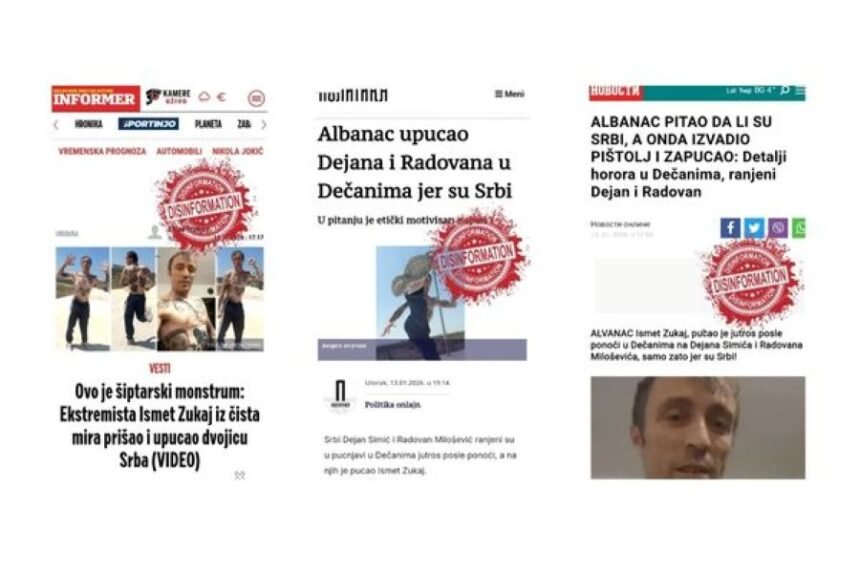
The Serbian daily Politika claimed in its headline that the attacker fired “because they were Serbs,” presenting an unverified motive as fact. The article completely omitted that an Albanian was also wounded, a detail that fundamentally challenges the claim of an exclusively ethnically motivated attack.
A similar approach was taken by Informer, which described the suspect as an “Albanian extremist,” focusing solely on the injured Serbs while deliberately ignoring the third victim, an Albanian. This selective reporting offered readers a distorted and incomplete account of the event.
Meanwhile, Večernje novosti, although mentioning later in the article that an Albanian was also wounded, excluded this information from its headline. Instead, the outlet emphasized a broader political narrative of an “attack on Serbs,” pushing crucial facts into the background.
The presence of an Albanian among the wounded clearly undermines claims that the shooting was an exclusively ethnically motivated act. Rather, the available facts point to a criminal incident whose motives have yet to be determined through institutional investigation.
Analysts warn that premature and selective framing of such incidents contributes to ethnic tensions, undermines public trust, and transforms unverified events into propaganda narratives before facts are established.