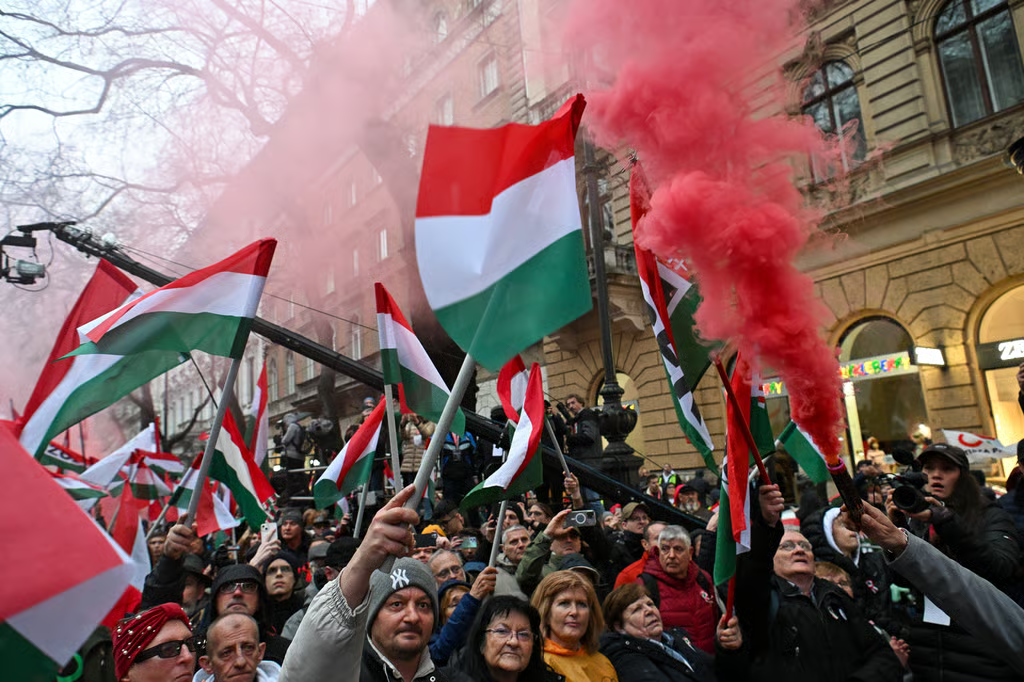
Hungary is preparing for one of the most consequential elections in the European Union in 2026, with Prime Minister Viktor Orbán facing an unusually strong challenger after 15 years in power. Hungarians will head to the polls on April 12, in a vote widely seen as a referendum on Orbán’s model of “illiberal democracy.”
The opposition is pinning its hopes on Péter Magyar, leader of the conservative Tisza party, which is currently leading Fidesz by around 12 percentage points in opinion polls. If confirmed at the ballot box, such a result could dramatically reshape Hungary’s domestic politics and its relationship with Brussels.
Why the Election Matters Beyond Hungary
Although Hungary has a population of just 9.6 million, Orbán’s leadership has made the country a major disruptor within the EU. His government has repeatedly used Hungary’s veto power to block sanctions against Russia, delay financial assistance to Ukraine, and stall key EU decisions.
Orbán is also the EU leader closest to Russian President Vladimir Putin and a central figure among right-wing populist governments opposing migration, LGBTQ+ rights expansion, and deeper EU integration. EU officials have increasingly expressed frustration, with some openly questioning whether the EU’s unanimity rule should remain in place.
Key Battlegrounds: Corruption, EU Relations, and Identity Politics
Magyar accuses Orbán and the ruling Fidesz party of corruption, nepotism, and weakening Hungary’s economy, arguing that confrontations with Brussels have cost the country billions in frozen EU funds.
Orbán, in turn, portrays Magyar as a Brussels-backed puppet, warning voters that a Tisza victory would mean surrendering Hungary’s sovereignty. Fidesz has sought to divide the opposition base through controversial issues such as LGBTQ+ legislation and Pride bans.
Tisza has largely avoided polarizing topics, focusing instead on winning an outright majority that would allow it to reform electoral laws and pursue constitutional changes. Party officials have warned of state propaganda, disinformation campaigns, and systemic bias favoring the ruling party.
How the Election Will Be Held
Hungary’s parliamentary elections will determine the makeup of the 199-seat National Assembly. Of these, 106 seats are elected in single-member districts, while 93 are allocated from national party lists.
According to POLITICO’s Poll of Polls, Tisza stands at 49 percent, compared with 37 percent for Fidesz. Smaller parties, including the Democratic Coalition, the far-right Mi Hazánk, and the satirical Two-Tailed Dog Party, risk failing to cross the parliamentary threshold, potentially leaving only two dominant right-wing parties in parliament.
Concerns Over Fairness and Democratic Standards
While observers do not expect direct interference with voting itself, Hungary’s electoral system heavily favors Fidesz, analysts say. Electoral districts were redrawn in 2011, and the ruling party benefits from vastly superior access to state resources and media, controlling an estimated 80 percent of the media market.
Voting rules also favor Fidesz supporters abroad, allowing ethnic Hungarians in neighboring countries to vote by mail, while other expatriates must travel to embassies.
Despite these imbalances, analysts stress that a Magyar victory remains possible if voter turnout is high and the integrity of the ballot is preserved.
What a Magyar Victory Would Mean
EU leaders are quietly hopeful that a Tisza-led government would ease tensions with Brussels and end Hungary’s role as the bloc’s primary spoiler. However, Magyar has carefully avoided positioning himself as an unconditional pro-EU figure, rejecting the idea of a European superstate and emphasizing national sovereignty.
On domestic policy, Tisza officials say they would maintain border controls, oppose mandatory migration quotas, resist fast-tracked Ukrainian EU membership, and counter Russian propaganda, signaling continuity on some sensitive issues.
Experts caution that real change would be slow, as key constitutional bodies and senior institutions remain staffed by Orbán-aligned officials. Only a two-thirds parliamentary supermajority, analysts say, would allow a new government to fully restore judicial independence, checks and balances, and rule-of-law standards.
A Turning Point for Hungary and the EU
With Orbán’s dominance under serious threat for the first time in over a decade, the April election is shaping up as a defining moment not only for Hungary, but for the future balance of power within the European Union.