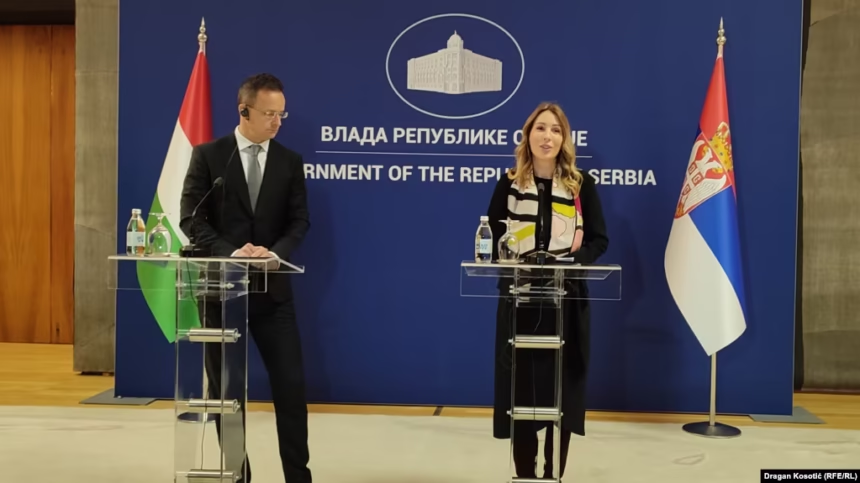
Hungarian Foreign Minister Péter Szijjártó announced in Belgrade that the Hungarian government is providing diplomatic support to the oil and gas company MOL in its effort to become the majority owner of Serbia’s Naftna Industrija Srbije (NIS), a company currently under U.S. sanctions due to its majority Russian ownership.
Szijjártó held talks with Serbia’s Minister of Mining and Energy, Dubravka Đedović Handanović, confirming that negotiations are ongoing between the Russian owners and MOL, while discussions are also taking place with other potential partners interested in acquiring the Russian majority stake in NIS.
“We have very good negotiations, and in the coming days the first significant step can be expected in talks between Gazprom Neft and MOL,” Szijjártó said.
NIS has been under U.S. sanctions since October, as Washington seeks to prevent Russia from using energy revenues to finance the war in Ukraine. For sanctions to be lifted, the U.S. administration requires the withdrawal of Russian ownership from NIS.
Minister Đedović Handanović stated that the goal is to sign a binding agreement on ownership transfer by the end of the week, paving the way for the exit of Russian shareholders and the buyout of their shares by new owners.
Following this step, Serbia plans to submit a new request to the U.S. administration to extend the license allowing negotiations, which is currently valid until March 24.
“We hope that, within this accelerated process, approval will be secured, and we are working on this through diplomatic channels with the United States,” Szijjártó added.
The two sides also announced plans to sign an intergovernmental agreement if MOL’s entry into NIS ownership is finalized.
Both ministers rejected claims that MOL would shut down the Pančevo Refinery, with Szijjártó emphasizing that MOL considers the refinery strategically important. He added that MOL has increased fuel exports to Serbia by two and a half times, making it the largest fuel exporter to the country.
Szijjártó accused Brussels authorities of attempting to worsen the energy situation in Southeast Europe and of cutting the region off from supply routes, arguing that EU sanctions have contributed to the energy crisis.
Meanwhile, the U.S. Treasury’s Office of Foreign Assets Control (OFAC) has issued a special license allowing NIS to continue operations until January 23, while negotiations on ownership changes are permitted until March 24. Crude oil transport to the Pančevo Refinery resumed on January 13 via the JANAF pipeline, after a temporary suspension due to supply disruptions.
Currently, Russia’s Gazprom, Gazprom Neft, and the St. Petersburg-based company Intelligence hold 56.15% of NIS shares, the Serbian state owns 29.87%, and nearly 14% is held by minority shareholders.