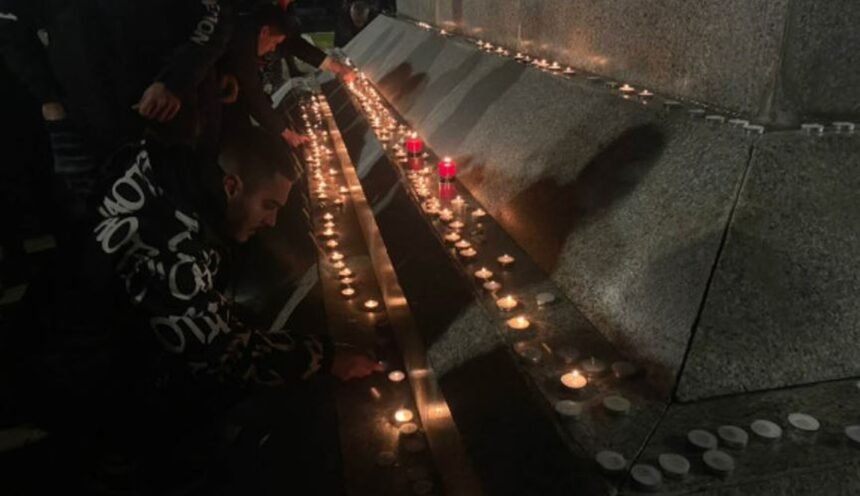
On the day of remembrance for genocide victims, over 10,000 civilians who were killed by the Serbian state during the last war in Kosovo were commemorated with candlelight ceremonies.
The remembrance event was organized by the Center “Genocide in Kosovo – An Open Wound” and OVL UÇK – Ferizaj Branch, in cooperation with associations of families of fallen and injured UÇK soldiers, the Association of Political Prisoners, the Association of the Missing, the “Çamëria” Association, and the Institute of War Crimes Committed in Kosovo.
Adnan Asllani, Deputy Chairman of the Center “Genocide in Kosovo – An Open Wound,” emphasized that a request has already been submitted to institutions to make the poppy flower the official symbol for commemorating genocide victims, in order to preserve the memory and honor the lives lost.
He noted that, so far, no response has been received.
“This concerns all victims – the 10,000 civilians killed and all those who suffered genocide at the hands of the Serbian state during the last war in Kosovo. We recall that on May 16, 2019, the Kosovo Parliament passed a resolution establishing January 15 as the official day of remembrance for genocide victims. This date coincides with some of the most horrific genocidal acts, including the Reçak massacre. Today, we light candles not only for Reçak, but for all those who fell, whose families were violently torn apart by Serbian forces,” Asllani said.
Bujar Dugolli, Chairman of the Center “Genocide in Kosovo – An Open Wound,” highlighted that the most recent crimes committed in Kosovo are well-documented.
“As is known, projects of genocide against the Albanians of Kosovo have occurred four times over the past 86 years. The last period, during the 1998–1999 war, is the most thoroughly documented nationally and internationally. Therefore, the genocide crimes that occurred in Kosovo during the last war are so well-documented that Serbia, as a genocidal state, can and must be held accountable for the crimes it committed in Kosovo,” Dugolli stated.
This commemoration served to underline the importance of remembering the victims and to raise voices demanding justice, while preserving the historical record of the tragedy endured by the people of Kosovo during the Second Kosovo War.