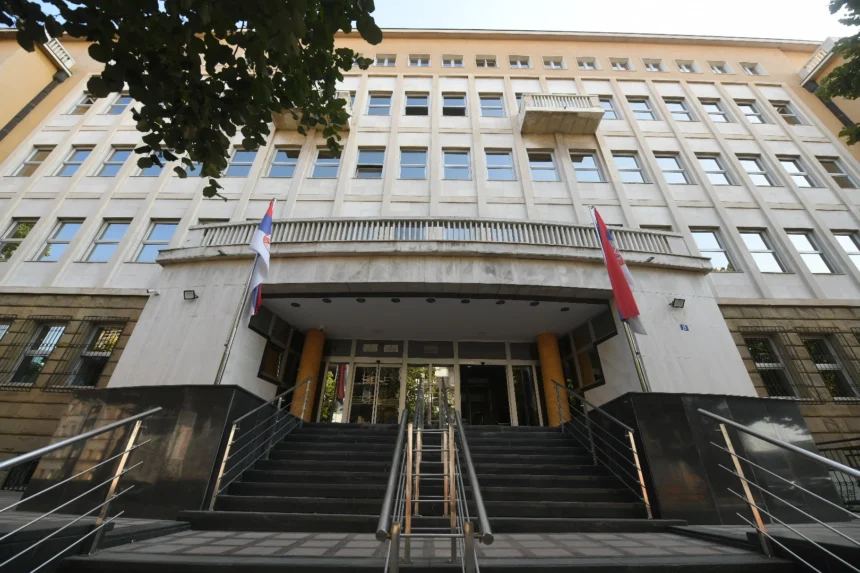
An amendment proposed by members of Serbia’s ruling Serbian Progressive Party (SNS) to the draft Law on Public Prosecutors could effectively halt the work of the Prosecutor’s Office for Organized Crime (TOK) and bring some of the country’s most significant criminal investigations to a standstill.
According to the amendment, prosecutors seconded from other offices to the Organized Crime Prosecutor’s Office would be limited to a maximum mandate of three years. In practice, this would mean that 11 prosecutors currently working in TOK as reinforcements would soon lose their mandates, severely undermining ongoing investigations and trials already underway.
Key Investigations at Risk
TOK currently employs 20 acting prosecutors, but adoption of the amendment would reduce that number by more than half. As a result, proceedings and investigations that could be stalled or terminated include:
- Jovanjica cases 1 and 2, as well as the ongoing investigation known as Jovanjica 3
- A new investigation into the drug cartel led by Darko Šarić
- Ongoing proceedings and further investigations into the “Vračar” criminal group
- Cases involving the “Balkan Cartel”
- The Romanov armed robbery trial
- All major financial investigations
These cases are highly complex and depend on prosecutors who have been working on them from their inception, making sudden personnel changes potentially devastating to their continuation.
Political Origins of the Amendment
The proposed changes to the Law on Public Prosecutors were originally submitted by SNS lawmaker Uglješa Mrdić. The controversial amendment itself was filed on January 13 by his party colleague Olja Petrović and officially entered parliamentary procedure the following day after being submitted to Speaker of Parliament Ana Brnabić.
Concerns Over Shielding Organized Crime
Critics argue that the amendment signals more than an attempt to limit prosecutorial mandates. It comes amid longstanding refusal by Serbia’s Ministry of Interior (MUP) to hand over Sky ECC encrypted communications obtained through European institutions—evidence considered crucial in multiple organized crime cases.
Investigative reporting has previously revealed that senior state officials are mentioned, both directly and indirectly, in available Sky ECC communications linked to criminal networks, including those associated with Darko Šarić. President Aleksandar Vučić is reportedly referenced under the codename “Oskar”, according to sources familiar with the material.
Pattern of Obstructing Investigations
This is not the first move perceived as an attempt to weaken TOK. Earlier, the Ministry of Interior withdrew all 32 police officers from a joint task force with TOK investigating corruption related to the reconstruction of the Novi Sad railway station and the construction of the rail line to the Hungarian border.
Combined with the proposed legislative changes, observers warn that these actions could effectively shut down Serbia’s Organized Crime Prosecutor’s Office, halting investigations into drug trafficking, financial crime, corruption, and contract killings.