
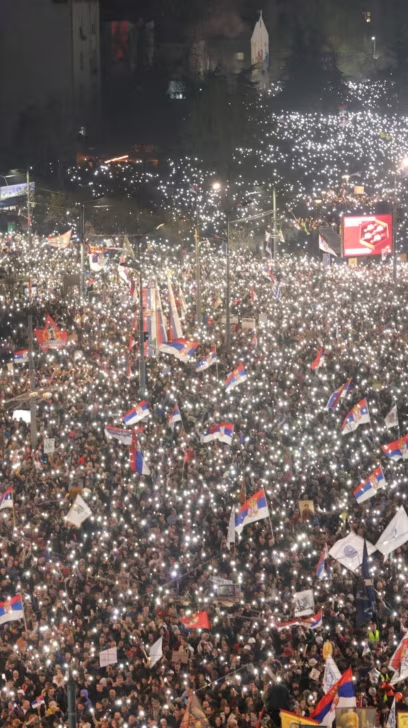
The European Commission has reiterated its call for Serbian authorities to investigate claims that a sonic cannon was used during the anti-government protest in Belgrade on March 15, 2025.
“As previously emphasized, we expect a swift, transparent, and credible investigation into allegations of the use of sonic weapons against demonstrators,” said the European Commission’s press service.
The renewed EU call comes after European media revisited the issue. Politico reported on January 15 that Serbian intelligence services, in cooperation with Russia’s Federal Security Service (FSB), had tested sonic weapons on dogs as part of an inquiry into demonstrators’ claims that such weapons were used during the protest.
European Commission officials confirmed they were aware of these “concerning reports.”
“Relations with Russia cannot proceed as usual, especially concerning security,” the Commission’s press service noted, reminding that under European human rights standards, authorities are obliged to protect protest participants from harm and violence.
Serbian Response and FSB Report
President Aleksandar Vučić previously presented the FSB’s report, which concluded that the prohibited sonic weapon was not used during the March 15 protest. The report, published on the website of Serbia’s Intelligence and Security Agency (BIA), stated that police-owned sonic devices were tested on dogs at a BIA training facility. According to the report, the dogs showed no signs of distress during or after the tests.
“Based on the results obtained, it can be categorically concluded that sonic devices were not used during the March 15 protest,” Vučić stated at the time. The Russian service did not comment publicly on the findings.
Serbian authorities, following demonstrator claims, had requested the Russian FSB to conduct an “independent investigation.” The U.S. FBI was also invited to assist, though no official response from the FBI has been reported.
Unresolved Questions and Health Concerns
The precise cause of the panic during the student protest remains unknown. Thousands of demonstrators, who have led massive protests since the deaths of 16 people in Novi Sad, reportedly fled the streets suddenly amid unusual loud sounds and vibrations.
In the days following the protest, many participants reported health problems, including dizziness, fainting, nausea, high blood pressure, and hearing issues.
Initially, Serbian authorities denied possessing sonic weapons, but later acknowledged police ownership, claiming they “have never been used.”
The European Union called for an immediate investigation, and the European Court of Human Rights, part of the Council of Europe, is also conducting a review.
Sonic cannons belong to the category of non-lethal weapons, which can be used for police and military purposes such as riot control, dispersing attacks, or long-distance communication.