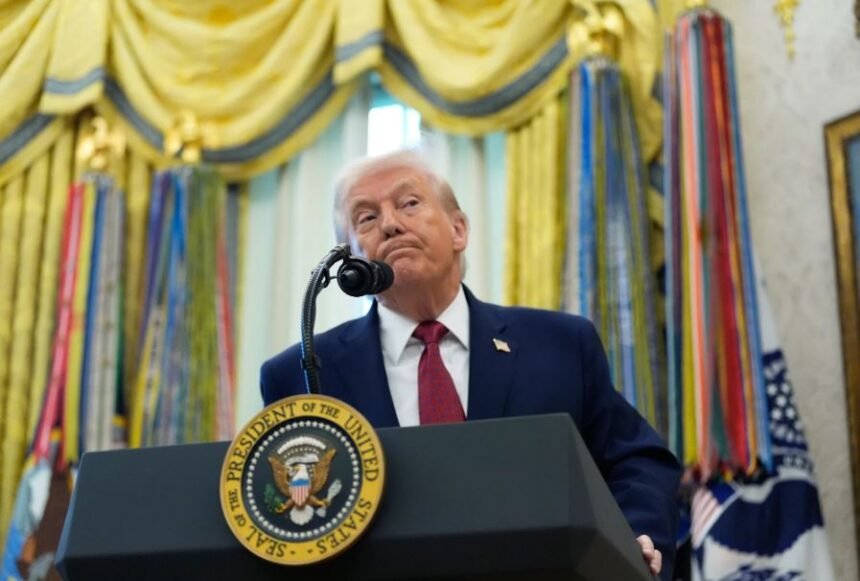
It has been one year since U.S. President Donald Trump entered the White House, assuming leadership of the world’s most powerful nation.
Since then, Trump has taken a wide range of decisions affecting the American public, national security, and the U.S. economy, reports IndeksOnline.
The U.S. Department of State (DASH) has released a list of what it describes as the most significant actions taken during Trump’s first year in office, including visa revocations, international withdrawals, counter-narcotics operations, and major foreign policy initiatives.
“One year ago, President Trump was inaugurated with a mandate to make America great again. Since then, he has delivered victory after victory for the American people,” the State Department said in its statement.
Key Decisions Highlighted by the U.S. State Department
- More than 100,000 visas revoked from foreign nationals, primarily involving individuals accused of crimes such as assault, theft, driving under the influence, or publicly endorsing violence against U.S. citizens.
- The Cartel de Los Soles was designated a Foreign Terrorist Organization, while President Trump ordered the arrest of alleged narco-terrorists Nicolás Maduro and Cilia Flores, described as fugitives from U.S. justice.
- Encounters at the southern border dropped by 99% since January, following a whole-of-government effort to curb mass migration. The U.S. signed seven Safe Third Country agreements to accelerate deportations.
- Immigrant visa issuance was suspended for 75 countries worldwide, pending enhanced vetting procedures aimed at preventing abuse of U.S. public resources.
- State Department–supported specialized units arrested key leaders of foreign terrorist and criminal organizations, including figures linked to the Sinaloa Cartel, MS-13, and Tren de Aragua.
- Four radical Antifa groups were designated as Foreign Terrorist Organizations, with the stated aim of cutting off funding and operational capacity.
- The State Department supported the implementation of President Trump’s Gaza Peace Plan, which it says ended the conflict, ensured the return of hostages, and expanded humanitarian access.
- Lebanese, Egyptian, and Jordanian branches of the Muslim Brotherhood were designated as terrorist organizations due to alleged material support for Hamas.
- A major reorganization of the State Department eliminated nearly 45% of domestic offices, strengthened embassies and regional bureaus, and refocused operations on U.S. national interests.
- The U.S. initiated withdrawal from dozens of international organizations, citing ideological bias, financial waste, and actions contrary to American interests.
- NATO allies committed to spending 5% of GDP on defense by 2035, a move projected to generate an additional $1 trillion annually in collective defense investment.
- The administration restructured foreign aid policy, dismantling what it described as a corrupt NGO industrial complex and shifting toward bilateral agreements and partner self-sufficiency.
- The State Department reported $1.8 billion in contract savings and $100 million saved on travel, while diplomatic security units supported major law enforcement operations in Washington, DC and Memphis.
- U.S.-supported law enforcement agencies seized nearly 350 tons of methamphetamine precursors in Mexico, destroyed over 80,000 acres of illegal coca crops in Peru, and confiscated 1,516 pounds of cocaine in El Salvador.
- Under Trump’s leadership, the State Department played a key role in negotiating and implementing the historic peace agreement between the Democratic Republic of Congo and Rwanda, ending three decades of conflict.
- The U.S. Institute of Peace was renamed the Donald J. Trump Institute of Peace, reflecting what the administration called the president’s unprecedented contributions to global peace efforts.
The statement concludes that the Trump administration will continue to prioritize American interests and maintain an “America First” approach.
Separately, in cooperation with the U.S.-led KFOR, a professional training exercise in skiing and avalanche search-and-rescue was successfully conducted in the Brod region, aimed at enhancing operational capacity and emergency readiness.