Finland, Denmark, and Sweden have long been skeptical of Russia’s so-called “shadow fleet,” while Germany had been more hesitant. That has now changed: the passage of certain vessels has been officially banned.
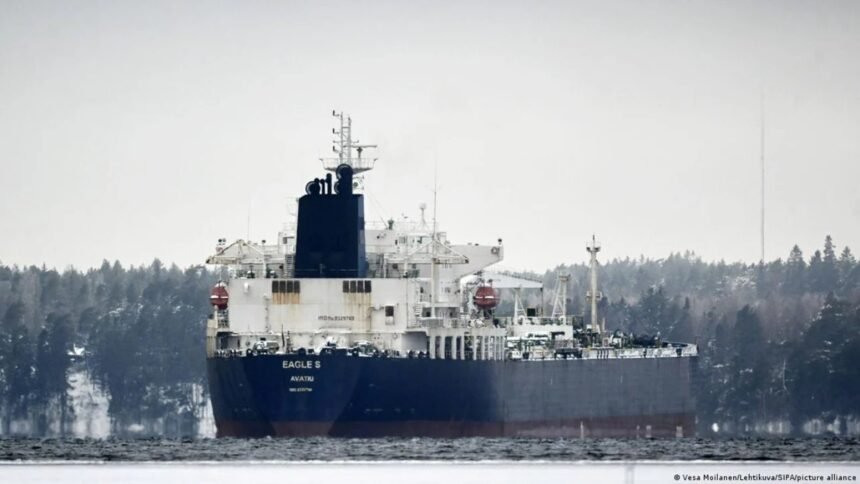
In the early hours of January 10, the tanker Tavian sailed through German waters in the North Sea. The vessel belongs to Russia’s shadow fleet, and German police classify it as a so-called “zombie ship” — a vessel that formally does not exist. The maritime police deployed a helicopter and ordered the ship’s captain to present the vessel’s documentation.
At the time, Tavian was sailing west from Schleswig-Holstein toward the Baltic Sea, most likely heading for one of Russia’s oil ports near St. Petersburg. Vessel movement data and airspace surveillance confirm that a German police helicopter did indeed approach the ship.
When Tavian passed Denmark and again neared German waters, this time close to Flensburg, the police delivered a clear message: it was prohibited from entering German territorial waters. A review of the documents confirmed suspicions — the vessel was sailing under a false flag and its identification number had been falsified. Tavian has been on the U.S. sanctions list since 2021.
Agreements Have Their Limits
The measure had an immediate effect. On Sunday evening, Tavian changed course and left the Baltic Sea. German police then informed the Ministry of the Interior about the incident. A police spokesperson declined to comment further.
This incident marks a turning point in Germany’s approach toward Russia’s shadow fleet. Until now, police and naval authorities had struggled to address the problem. Around 500 old and poorly maintained tankers form the backbone of the network through which Russia circumvents sanctions on oil exports. These ships directly fund Russia’s war effort by transporting billions of dollars’ worth of oil that would otherwise have to be sold at a much lower price. Under EU rules, Russian oil may only be exported at a price 15 percent below the global market level.
Some shadow fleet vessels have also been linked to espionage and sabotage activities.
False Flags
Western countries have long assumed that ships — including Russian tankers — could rely fully on the right of “innocent passage” under the UN Convention on the Law of the Sea. This right allows vessels to pass through another state’s territorial waters, provided they pose no hostile intent and without boarding.
In addition, the Baltic Sea has long been subject to an obligation of unrestricted navigation for all states with access to it — a principle that applied even during the Cold War.
However, this interpretation is now changing. The convention requires every ship to sail under its genuine national flag. If a vessel has no flag or sails under a false one, it loses the right of passage, experts say. The same applies if the passage is not peaceful or poses a security risk.
The United States has recently relied on this provision, blocking several shadow fleet vessels.
Full Political Support
Marc Henrichmann (CDU), chairman of the parliamentary committee overseeing Germany’s intelligence services, is calling for the existing legal framework to be used to its full extent.
“We must not allow despots like Putin to mock us. We have to show that breaking the law has consequences,” he said. In his view, dangerous tankers should be detained and permanently removed from traffic.
Green Party MEP Robin Wagener believes tougher action against the shadow fleet is long overdue: “Innocent passage does not apply to ships sailing under false flags and posing a danger. We must act. These vessels are an environmental threat and platforms for espionage, sabotage, and drone deployment.”
Germany’s tougher stance is also evident in other cases. According to NDR, WDR, and Süddeutsche Zeitung, the Russian research vessel Akademik Boris Petrov was recently denied entry into German territorial waters.
Another Flag Still at Anchor
A second case involves the tanker Chariot Tide. On the night of December 5, 2025, the vessel slowed down, reported technical problems, and dropped anchor in the German part of the North Sea — just a few miles from an underwater cable. This ship was also sailing under a false flag.
A year earlier, a shadow fleet tanker in the Baltic Sea damaged an underwater cable with its anchor. This time, German authorities reacted decisively: the navy dispatched the frigate Baden-Württemberg, and police deployed the vessel Potsdam.
German officers boarded the tanker and conducted an inspection. Notably, the ship changed its flag while still at anchor — one day it was registered as a Gambian vessel, the next day as Mozambican.
No More Warship Escorts
The changed legal interpretation is not the only reason for the West’s tougher approach. For years, Russia kept its warships close to these tankers to protect them in case of intervention. But according to security sources, the Russian Navy can no longer sustain this logistically.
The “zombie tanker” Tavian was not escorted by Russian warships. It changed course and is now sailing toward Russia’s North Sea waters.