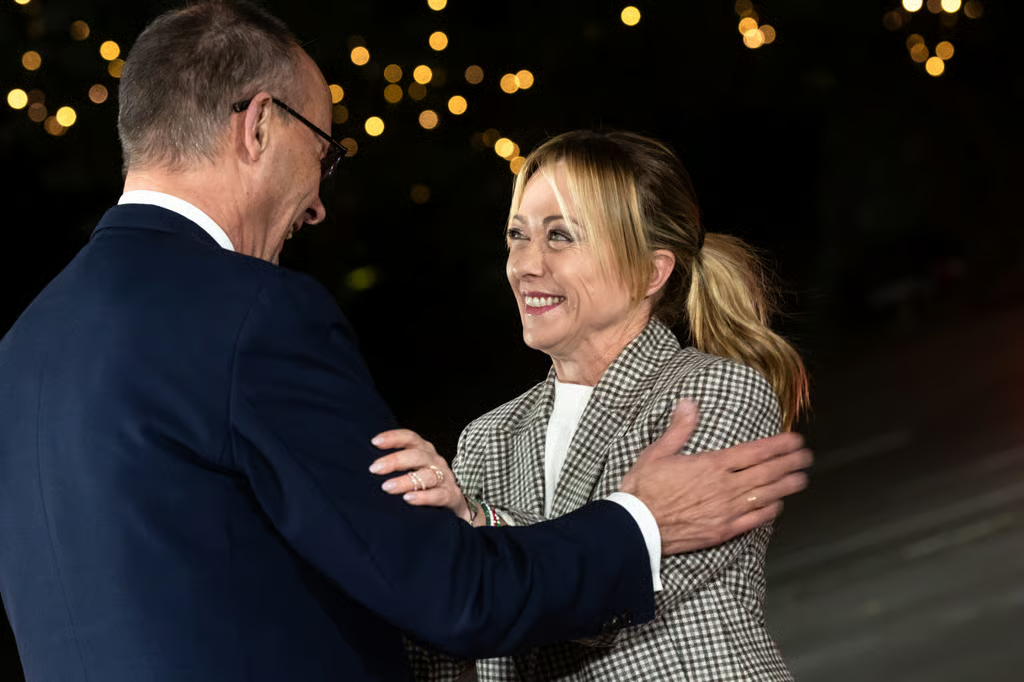
As the traditional Franco-German partnership shows signs of strain, German Chancellor Friedrich Merz is increasingly turning to Italian Prime Minister Giorgia Meloni as a key strategic ally in shaping the European Union’s future.
With Berlin and Paris struggling to align on trade, defense, and industrial policy, Merz is recalibrating Germany’s European strategy by strengthening ties with Rome. The two leaders are expected to deepen their cooperation during a high-level summit in Rome, signaling a potential shift in the EU’s internal balance of power.
A Strategic Shift Away from Paris
For decades, Germany and France formed the core engine of EU decision-making. However, tensions with French President Emmanuel Macron—particularly over the Mercosur trade agreement and a €100 billion joint fighter-jet program—have pushed Berlin to seek alternatives.
Germany is frustrated by France’s resistance to Mercosur, a deal Berlin sees as vital for boosting European industrial exports. Against this backdrop, Italy has emerged as a pragmatic and willing partner, aligning more closely with Germany’s economic priorities.
Defense, Industry, and Trade at the Core
At their Rome summit, Merz and Meloni are expected to formalize cooperation on defense, building on existing industrial ties such as the Rheinmetall–Leonardo joint venture for military vehicles.
More ambitiously, Germany and Italy are drafting a joint position paper ahead of the February 12 European Council summit, aimed at:
- Reviving EU industry
- Expanding exports
- Reducing regulatory burdens
- Accelerating stalled trade agreements
Both governments describe themselves as Europe’s two leading industrial nations, a characterization likely to irritate Paris.
Shared Atlanticism and Trump Factor
Merz and Meloni are also united by their Atlanticist outlook and a desire to avoid confrontation with U.S. President Donald Trump. Both leaders have positioned themselves as Europe’s most open voices for dialogue with Washington, contrasting with Macron’s more confrontational tone.
According to diplomats, this shared approach has reinforced trust and political chemistry between Berlin and Rome, supported by their respective foreign ministers.
Not a Perfect Alliance
Despite the growing closeness, the partnership remains largely tactical rather than strategic.
Key differences persist:
- Italy favors looser EU fiscal rules, while Germany has long defended strict budget discipline.
- Meloni opposed Merz’s proposal to use frozen Russian assets for Ukraine.
- Rome and Berlin may diverge again on EU-level defense financing, where Italy often aligns more naturally with France.
Still, recent developments show some convergence, with Meloni cutting Italian spending and Merz overseeing a historic expansion of German debt-funded investment in defense and infrastructure.
A Marriage of Political Convenience
Analysts agree that the Merz–Meloni alignment reflects domestic political realities. Meloni has moderated her nationalist party’s foreign policy stance, while Merz has shifted rightward on migration amid pressure from Germany’s far-right AfD.
This ideological convergence has created space for cooperation on migration control, trade expansion, and EU reform, positioning Meloni as an increasingly influential figure in Merz’s European strategy.
A New Balance in the EU?
While the alliance has limits, Italy has successfully leveraged tensions between France and Germany to strengthen its role within the EU. As one expert put it, Meloni has seized the opportunity to move closer to Berlin at a moment when the Franco-German axis is faltering.
Whether this partnership evolves into a lasting pillar of EU leadership remains uncertain—but for now, Merz and Meloni are emerging as a powerful new duo in European politics.