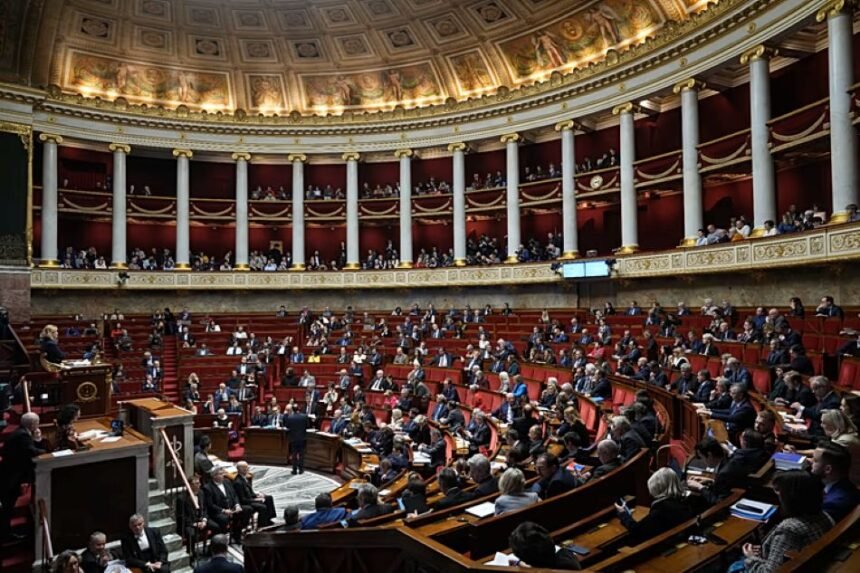
The French government has narrowly avoided collapse after surviving two no-confidence motions in the National Assembly, following a heated parliamentary showdown over the 2026 state budget.
The motions were tabled by the hard-left party France Unbowed (LFI) and the far-right National Rally (RN) in response to the government’s decision to push through part of the budget using Article 49.3 of the Constitution, which allows legislation to be adopted without a parliamentary vote.
Moderate Parties Block Government Ouster
Neither the Socialist Party nor the conservative Republicans supported the motions, enabling Prime Minister Sébastien Lecornu to remain in office.
- The first motion, initiated by LFI, secured 269 votes, falling short of the 288 required to bring down the government.
- The second motion, proposed by RN, attracted even fewer votes.
Controversy Over Use of Article 49.3
Both opposition blocs accused the government of abusing constitutional powers. Far-right leader Marine Le Pen described the budget process as “a humiliating parody”, arguing that while Article 49.3 is legal, its use in this case amounted to “an abuse of the Constitution.”
Prime Minister Lecornu defended the move, stating that “compromises have been found” and insisting that the mechanism was used only as a last resort, due to what he described as parliamentary paralysis.
Socialists Warn Against Political Instability
The Socialist Party justified its refusal to support the motions by warning that toppling the government would trigger a deep political crisis. Socialist MP Laurent Baumel cautioned that instability would further damage France’s already fragile political landscape.
The Socialists softened their stance after the government made last-minute budget concessions, while conservatives echoed similar concerns. Republican MP Nicolas Ray argued that allowing the budget to pass was “what the French people are asking of us.”
Political Deadlock Continues
France has faced ongoing political turbulence since President Emmanuel Macron called snap parliamentary elections in June 2024, resulting in a deeply fragmented National Assembly split into three major blocs, none holding an absolute majority.
Emboldened by the failure of the no-confidence votes, the government has invoked Article 49.3 again, this time on the expenditure section of the budget. Additional no-confidence motions are expected, though they are also likely to fail.
Budget Pressure and EU Deficit Rules
France remains under intense pressure to rein in public finances, with the budget deficit reaching 5.4% of GDP last year. Paris has pledged to bring the deficit below 3%, in line with European Union fiscal rules.
Following a brief review in the Senate, the budget is expected to return to the National Assembly for a final use of Article 49.3, potentially concluding a tense and prolonged budgetary process—provided the government survives until then.