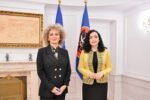
Just over a year after a failed attempt, on Thursday evening the European Union managed to bring representatives of Kosovo and Serbia together in a joint meeting, officially functionalizing the Joint Commission on the Missing Persons.
Acting Deputy Prime Minister for Dialogue, Besnik Bislimi, described the meetings that launched the commission as successful. The commission’s mandate is to oversee the implementation of the Joint Declaration on Missing Persons, reached on May 2, 2023.
Andin Hoti, chair of the Government Commission for Missing Persons, wrote that Kosovo requested full implementation of the declaration, including access to classified archives of Serbian institutions and the military, as well as acceleration of fieldwork.
The EU Special Representative for the Kosovo-Serbia Dialogue, Peter Sorensen, said the commission aims to “shed light on the fate of missing persons, including those taken by force.”
“The European Union has high expectations that the Joint Commission will make a significant contribution to clarifying the fate of missing persons and help close a painful chapter for families who have waited far too long for answers,” Sorensen said.
Even though the agreement was welcomed as good news, based on decades of experience, the Kosovo Humanitarian Law Fund (FDH) does not hold high expectations.
Bekim Blakaj, director of FDH Kosovo, emphasized that “unfortunately, over the years, the issue of missing persons has been treated more politically than humanely,” which leads to diminished hope and disappointment.
“We are not very optimistic that all points of the Joint Declaration will be implemented. Some of them may be, such as including victims’ families in the process, better informing them, and perhaps exhumations or tracing suspected mass grave locations,” Blakaj said.
While he welcomed that the parties are expected to meet more frequently, Blakaj remains skeptical about archive access, as full access could open the door to legal accountability.
“Certain archive files may be opened, but the data on clarifying the fate of missing persons might not be in those archives, or certain elements may have been removed long ago. I say this because it could also entail criminal responsibility,” Blakaj explained.
On May 2, 2023, in Brussels, Kosovo Prime Minister Albin Kurti and Serbian President Aleksandar Vučić agreed on the Joint Declaration on Missing Persons, committing that this issue would be treated humanely and urgently.
However, nearly two years and eight months later, the first meeting of the Joint Commission took place – its functionalization had been blocked by Serbia, initially by refusing to agree on the Terms of Reference and later by not attending the first constitutive meeting.
According to the Terms of Reference, agreed in December 2024, six meetings are to be held within the first six months from the commission’s functionalization – one per month.