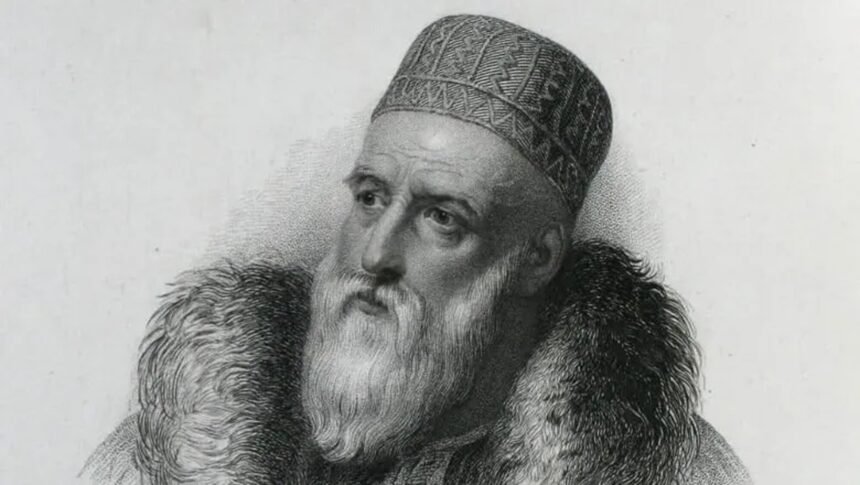
Today marks 204 years since the assassination of Ali Pasha of Tepelena, the most powerful ruler and feudal lord of Central and Southern Albania.
Known as the “Lion of Ioannina,” Ali Pasha of Tepelena is best remembered in Albanian historiography as the founder of the autonomous Pashalik of Ioannina and as a rebel against the authority of the Ottoman Porte in Albania.
The “Lion of Ioannina” was born around 1740–1750 in Tepelena, in the Labëria region, and died on 24 January 1822 while defending the Albanian lands of Epirus against Ottoman forces. Ali Pasha’s family was among the most influential in the Albanian territories. His great-grandfather, Muçojaka, was a bey from Gjirokastra and is believed to have served as deputy governor of the nahiya of Tepelena, which at the time was part of the Sanjak of Vlora.
His grandfather, Muhtar Pasha, was a warrior renowned for his bravery and died during the siege of Corfu in 1716, after destroying part of the Venetian fortifications while commanding Ottoman forces.
Muhtar Pasha had three sons: Salek, Mehmet, and Veli. From a young age, Ali Pasha of Tepelena quickly distinguished himself through his abilities and the determination with which he pursued his ambitious plans to become the sole ruler of the land, using all available means—violence, cunning, as well as family alliances with other local feudal lords.
After his grandfather’s death in battle and the loss of his father, Veli, the family faced great hardship. In his youth, Ali gathered a band of raiders and was responsible for several raids until his arrest by the Pasha of Berat. He managed to escape punishment by entering his service, later transferring to the service of one of the Pasha of Berat’s rivals, the Pasha of Delvina. Ali married the latter’s daughter, with whom he had two sons, Muhtar and Veli. Soon after, he began plotting against his father-in-law, hoping to inherit his pashalik following his execution.
In 1784, Ali gained the rank of Pasha as a military commander under the Vali of Rumelia in Sofia. That same year, he secured control of the Sanjak of Delvina through warfare. Between 1786 and 1788, he became derbend pasha and governor of the Sanjak of Trikala (Thessaly), and—supported especially by the local artisan and merchant bourgeoisie—he took control of the important Sanjak of Ioannina, extending his authority over Epirus and parts of southern Albanian territories.
Around 1787, Ali Pasha was summoned to Constantinople and appointed as Dervendji Pasha (a military marshal) over all of Thessaly, authorized to maintain a force of four thousand men to fight brigands. Having once been an outlaw himself, he knew their methods well and often recruited them into his own service rather than eliminating them. The Sultan rewarded him by confirming him as Ali Pasha in Trikala.
As a major landowner, tax farmer, active participant in trade, and protector of both emerging landowners and the commercial bourgeoisie—whom he won over through a policy of broad religious tolerance—Ali Pasha marginalized supporters of the Ottoman central authority and local feudal “petty tyrants,” whom he viewed as sources of feudal anarchy. The territories under his rule were transformed into a de facto autonomous state formation, distinguished from other parts of the empire by order, stability, and economic and cultural development. Ioannina became one of the most important and prosperous cities in the western Balkans, a major commercial center of southern Rumelia and a hub of education and culture, where alongside Greek, the Albanian language also began to be used in writing.
Between 1798 and 1812, by subduing rival sanjak governors and self-governing regions such as Suli and Himara, and by exploiting the Ottoman Empire’s weakened position during the Napoleonic Wars, Ali Pasha expanded and consolidated his power from the Gulf of Preveza to approximately the Shkumbin River. The Pashalik of Ioannina emerged as an important international factor, attracting the attention of France, Russia, and Britain, which established direct diplomatic relations with him, bypassing the Ottoman Porte.
Ali Pasha of Tepelena thus became a ruler who was effectively independent, yet cautious not to provoke premature conflict with the central authority, waiting instead for a favorable moment to break away entirely.