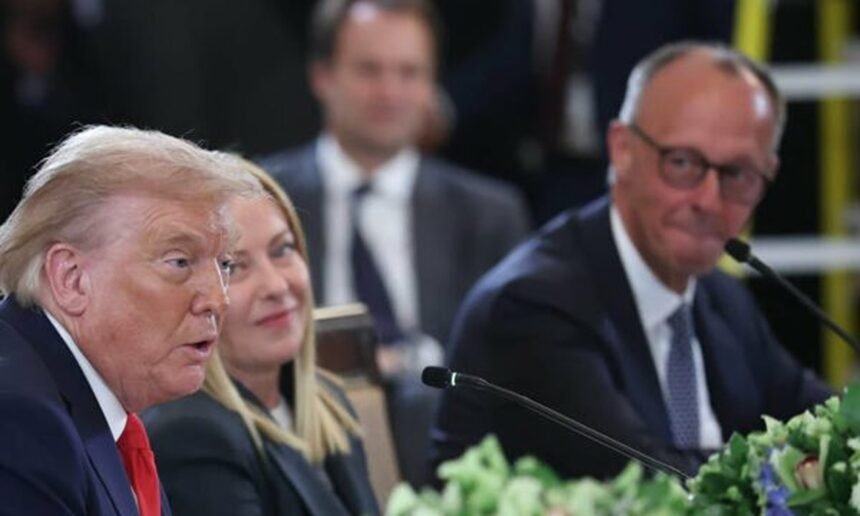
German Chancellor Friedrich Merz and Italian Prime Minister Giorgia Meloni insisted on Friday that they would have been willing to join U.S. President Donald Trump’s “Peace Board,” but were prevented from doing so by constitutional barriers.
Their refusal to join Trump’s Peace Board—an integral part of his post-conflict governance plan for Gaza—appeared to be a strategic way to avoid offending the U.S. president. Meloni and Merz are considered two of Trump’s closest allies within the EU and are at the forefront of efforts to ease transatlantic tensions.
Within the EU, only Hungary and Bulgaria signed Trump’s initiative, while concerns were raised over invitations extended to authoritarian countries such as Russia and Belarus.
Seeking a diplomatic way out, Rome and Berlin pointed to their constitutions.
“We are ready. But of course there are objective problems with how the initiative is structured,” Meloni said in Rome on Friday during a joint press conference with Merz.
“I have also spoken with the American president about this. Perhaps we can try to resolve these issues,” she added.
Meloni argued that Trump’s Peace Board would conflict with a provision of the Italian constitution that prevents the country from joining international bodies in which one entity—in this case the U.S. president—would wield more power than his counterparts.
Merz, who was in Rome for consultations aimed at strengthening German-Italian cooperation within the EU, supported Meloni’s remarks.
“I personally would be willing to join a peace board,” Merz said. He added: “We cannot accept the governing structures, including for constitutional reasons in Germany. But we are, of course, willing to try other forms—new forms of cooperation.”
Germany had previously welcomed Trump’s invitation but remained undecided. German officials said Berlin’s aim was to formulate a unified response to Trump’s Peace Board plan, while stressing that the United Nations should remain the primary multilateral forum for conflict resolution.
Merz and Meloni spoke a day after EU leaders met for an emergency summit in Brussels—organized earlier this week amid Trump’s threats to invade the Arctic territory of Greenland and impose new tariffs on European countries.
During the meeting, European leaders agreed that the post–World War II order is eroding, but they did not reach a consensus on the best strategy for dealing with Trump.