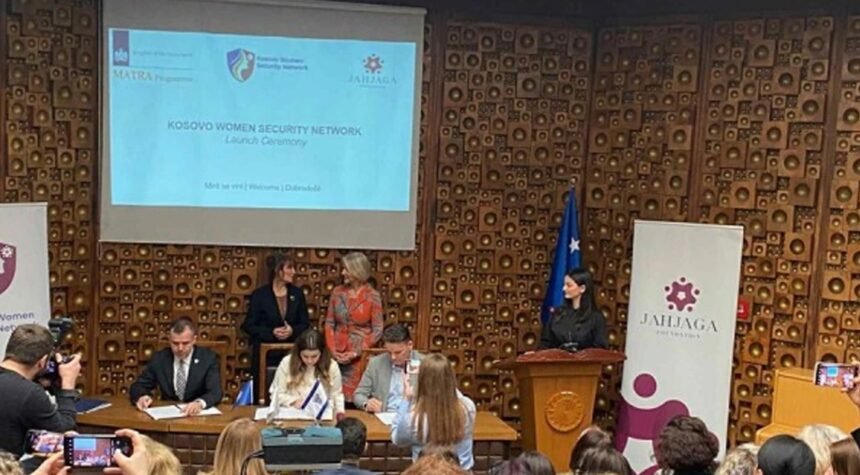
The Jahjaga Foundation on Monday launched the Women in Security Network, which aims to serve as a support mechanism complementing existing security institutions in Kosovo.
During the ceremony, cooperation memorandums were signed with the Kosovo Police, the Kosovo Security Force (KSF), the Police Inspectorate, and other relevant institutions.
The founder of the Jahjaga Foundation, Atifete Jahjaga, stated that Kosovo is the first country in the world to launch such a network.
The former president emphasized that the network is designed as a supportive mechanism that complements existing structures, without replacing institutional mandates.
“Today we are launching something that will serve not only women, but also our security institutions themselves. Women are an active part of our security institutions, and this has been proven over decades. Their contribution—your contribution—is undeniable in policing, defense, institutional oversight, and emergency management. This network is conceived as a support mechanism that complements existing structures; it does not replace mandates or competencies, but strengthens them through professional cooperation and continuous dialogue. Through this network, participating women can share best practices, learn from one another, and build joint initiatives,” Jahjaga said.
The Executive Director of the Jahjaga Foundation, Egzona Bexheti, described the network as a “strategic turning point for Kosovo, going beyond the aspiration for equality.”
“There can be no sustainable security without the meaningful inclusion of women. The establishment of the Women in Security Network marks a strategic shift in Kosovo, moving beyond the aspiration for equality. This network will serve as a bridge of cooperation, a space where women’s professionalism and commitment are translated into decision-making power in service of society as a whole,” she stated.
Meanwhile, the Chargé d’Affaires of the Embassy of the Netherlands in Kosovo, Desiree Bonis, said that women remain underrepresented in the security sector, stressing that the Women in Security Network is an investment in long-term change.
“The Netherlands strongly believes that security institutions gain legitimacy and legality when they are rooted in accountability and inclusiveness. We know that challenges in the security sector exist in Kosovo and are neither abstract nor new. Fragile trust between civil society and the northern part of Kosovo affects public security and social cohesion. At the same time, women remain significantly underrepresented in security institutions, particularly in leadership and decision-making roles, with figures ranging from 10–12% up to 30%. With the establishment of this network, it is clear that this is not just a platform—it is an investment in people, in leadership, and in long-term change,” she said.
The launch of the Women in Security Network was supported by the Embassy of the Kingdom of the Netherlands in Kosovo through the MATRA project.