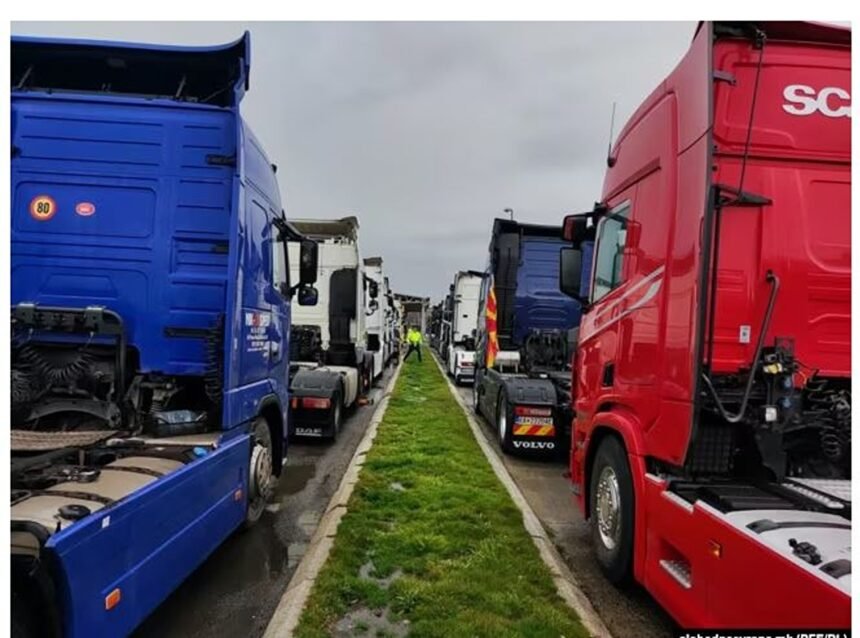
Hauliers from Serbia, North Macedonia, Bosnia and Herzegovina, and Montenegro blocked border crossings for the movement of goods toward the European Union’s Schengen Area starting midday on January 26.
This action is a response to the EU’s new Entry/Exit System (EES), which transport operators say has led to deportations, long delays, and economic losses. They are demanding that transport companies be exempted from the system’s application.
The hauliers announced that the blockades will last seven days unless a solution is found within that period.
As an importer of many goods via Serbia and North Macedonia, Kosovo is expected to feel the consequences of the protests on the flow of transport vehicles. Kosovo’s National Center for Border Management announced that, based on information received from Serbian border officials, “there will be interruptions to truck traffic at all border crossings with Serbia.”
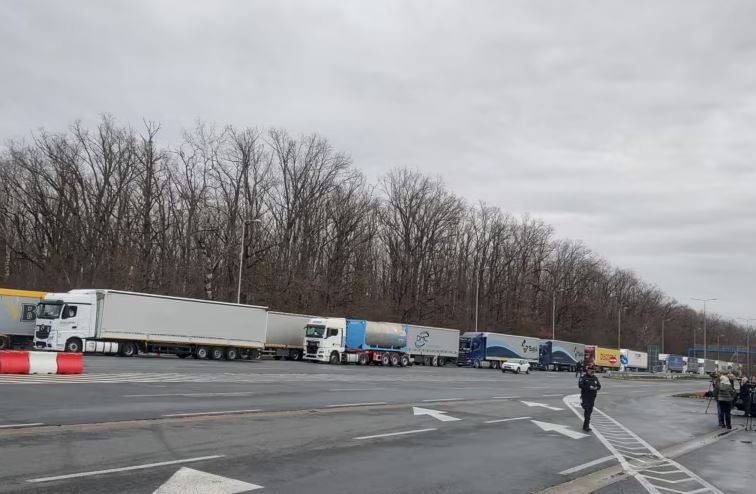
“These protests affect the movement of transport vehicles and goods and overload traffic in the border areas of the Republic of Kosovo with regional countries involved in the protests,” the statement said.
The National Center for Border Management also warned that similar blockades will occur from Montenegro.
The head of the Kosovo Chamber of Commerce (KCC), Lulzim Rafuna—also leader of the Western Balkans Chambers of Commerce—said Kosovo is not participating in the protest, as it does not yet have logistics companies that carry out regular transport to EU countries. However, he warned that the effects will still be felt in Kosovo.
“Due to the border blockades, Kosovo will not be able to export or import goods,” Rafuna told Radio Free Europe.
According to Kosovo Customs data for last year, the country imported products worth over €7 billion in total—around €20 million per day—much of it via Serbia and North Macedonia. Exports, meanwhile, amounted to approximately €942 million last year, or around €2.6 million per day.
In an effort to find a solution, Rafuna said that six Chambers of Commerce from the Western Balkans have sent a letter to the President of the European Commission, Ursula von der Leyen. The letter, dated January 20 and obtained by Radio Free Europe, calls for a sustainable solution to the issue.
“The expected developments resulting from these measures are concerning and could turn into a systematic economic and political challenge for the region,” the letter states.
According to Rafuna, the new system has forced companies in the Western Balkans to hire new drivers every three months.
“This is a major problem because there is a shortage of drivers… and it completely disrupts the supply chain,” he said.
The Vice President of the Kosovo Association of Freight Transporters, Besnik Aliu, told Radio Free Europe that transporters in Kosovo face challenges similar to their regional counterparts due to the EES system. Although around 2,000 trucks are licensed for freight transport in Kosovo, the sector remains weak in international transport, as most imports and exports are carried out by companies from the region and the EU.
“It is not easy to find drivers for the EU market, as it is for transport within Kosovo or the region,” he said.
Speaking to Radio Free Europe, Sasho Ilievski, owner of “Stema Transport” in Skopje, said he is not directly affected by the new rules—since his trucks travel to nearby EU countries—but added that he supports colleagues in the protest.
“Our trips are mainly to Austria, Slovakia, the Czech Republic, and Hungary. For each trip, we stay a maximum of four to five days,” he said.
“However, there are companies that operate deeper inside the EU… entering Sweden, Norway, Portugal. For one trip, they spend 15 to 20 days within the EU. When they return, they are not allowed to re-enter again that month. If they do not travel again, the company and the business suffer losses, because drivers cannot meet their professional obligations during that time. They are not tourists—they are professional drivers and should be allowed to stay longer,” Ilievski added.
Before the EES electronic system came into force, Macedonian transporters had no such problems, even though the 90-day Schengen stay rule was already in effect. Border officers stamped passports but did not strictly count days, Ilievski said.
Since the launch of the EU’s electronic system, stays in the Schengen Area are now monitored far more strictly. The biometric database accurately records all days spent—from driving time and rest periods in parking areas to waiting times at borders.
“Anyone traveling deeper into the European Union will stay more days. This affects about 70 percent of companies in the country. Colleagues in Sweden, for example, cannot return quickly… Drivers are allowed to drive nine hours a day and then must rest. That rest takes place inside the EU and is also counted as a stay, even though they are not working,” Ilievski explained.
“That is why we are asking the EU to exempt transport companies. Either drivers should be allowed longer stays, or only their working hours should be counted,” he said.
Macedonian hauliers will block ten border crossings—with Bulgaria, Greece, Albania, and Kosovo. The Tabanovce border crossing will not be blocked by Macedonian hauliers, but by Serbian transporters on their side of the border, who have already blocked other crossings.
The blockades apply only to freight traffic, closing lanes and terminals for trucks, while private vehicles, buses, and passenger traffic will move without disruption.
In North Macedonia, mobilization for the blockades was organized by “Makam-Trans,” the country’s largest association of transport company employers. Its Secretary General, Bilana Muratovska, said Macedonian drivers—like others in the region—face the risk of deportation after exceeding the 90-day stay in the Schengen Area.
Earlier, the Logistics Consortium of Bosnia and Herzegovina announced that 100 professional drivers had been forcibly returned from EU countries, while 47 drivers lost their jobs due to residency issues.
“We have such cases as well. I don’t have an exact number, but a distinction must be made… for example, the transport fleet in Bosnia and Herzegovina and in Serbia is much larger than ours,” Muratovska said.
She added that the damages for companies are significant and generate additional costs.
“When we calculate the costs incurred—because the vehicle is left in a parking lot full of goods, which can be very expensive and unsecured, and we do not know what will happen to the drivers—the situation becomes very difficult. Drivers are deported by plane because they do not have enough days to return by bus or with colleagues. These costs are borne by the transport companies,” Muratovska explained.