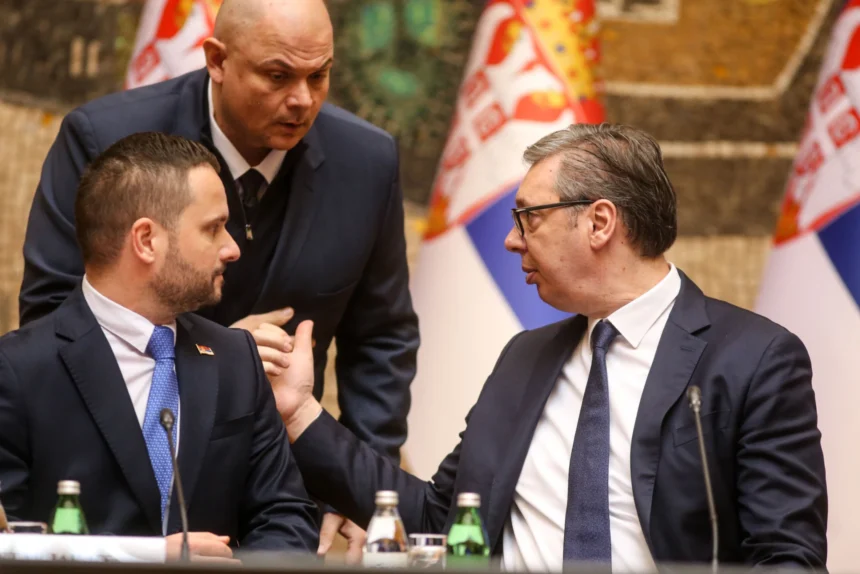
The recent so-called “thematic” session of the Serbian government, attended and effectively chaired by President Aleksandar Vučić, once again exposed how political power in Serbia is performed rather than exercised through institutions.
Broadcast live by numerous television channels and online portals, the event followed a now-familiar pattern: a carefully staged media spectacle that blends populist theatrics with authoritarian spin, reducing state institutions to props and democratic procedures to empty rituals.
At a moment when Serbia is experiencing its longest wave of social protests in recent history, such performances function as a regime response to crisis — not through reform or accountability, but through intensified spectacle.
Power as Performance, Not Governance
Although the Constitution allows the president to attend government sessions, Vučić’s presence consistently transforms them into choreographed demonstrations of dominance that exceed constitutional boundaries. Repeated over years, these appearances send a clear emotional message rather than an institutional one:
“I alone control this system.”
His aggressive, personalized, and commanding tone is not aimed at disciplining ministers, who are already politically subordinate, but rather at disciplining voters. Ministers serve as symbolic targets — proof of the president’s supposed vigilance — while real accountability never materializes.
This visual and narrative erasure of institutional boundaries reduces the executive branch to an extension of a single individual, turning governance into a performance of sovereignty built on the suspension of rules and procedures.
Manufactured Conflict and Media Recycling
These sessions are pseudoevents, designed for endless circulation across Serbia’s media ecosystem. Clips of the president shouting, sighing, displaying irritation or rage are transformed into headlines, viral videos, memes, and tabloid narratives.
Each iteration further normalizes autocratic behavior and strengthens the emotional bond between leader and audience. The spectacle becomes self-reproducing — so omnipresent that manipulation itself becomes invisible.
Rather than reflecting reality, the media actively replace it with a hyperreality, where Serbia’s main problems are framed as “lazy ministers” or the “previous government,” while systemic corruption, institutional collapse, falling living standards, and youth emigration are pushed aside.
Populism Meets Spin Dictatorship
Vučić relies on the classic populist binary: “me versus them.” He casts himself as the defender of the people, work, discipline, and responsibility, while ministers are portrayed as an incompetent, corrupt elite.
By publicly humiliating them, he signals “authenticity” — a leader who “says what the people think” and has no time for formalities. In doing so, institutions are discredited while personal authority is glorified.
This goes beyond populism. Democracy and the Constitution are not formally suspended, yet from the highest office comes a continuous message — explicit or implicit — that laws, rules, and procedures are meaningless.
Citizens as Children in a Disciplinary Play
Perhaps the most cynical aspect of this spectacle is its contempt for citizens.
When Vučić publicly scolds ministers for “inaction,” the assumption is that citizens will believe the performance of discipline, failing to notice that:
- the same ministers remain in office,
- nothing fundamentally changes,
- performance has replaced politics.
Citizens are treated not as rational actors, but as an audience — valuable only for applause, likes, and shares. This creates a form of systematic gaslighting, where lived reality is denied and replaced by the image of a “strong state” led by a tireless leader.
Politics Reduced to Emotional Management
In today’s Serbia, political communication has become emotional management. Power does not communicate to inform, include, or respond — it produces waves of fear, anger, hope, and frustration, channeling them into loyalty or apathy.
Ministers are props. Citizens are spectators.
The only true protagonist is the leader, whose media performance substitutes for governance.
The harshest truth revealed by these spectacles is that they are not designed to hide contempt — but to display it openly, confident that even when citizens recognize it and resist, there will be no institutional consequences.