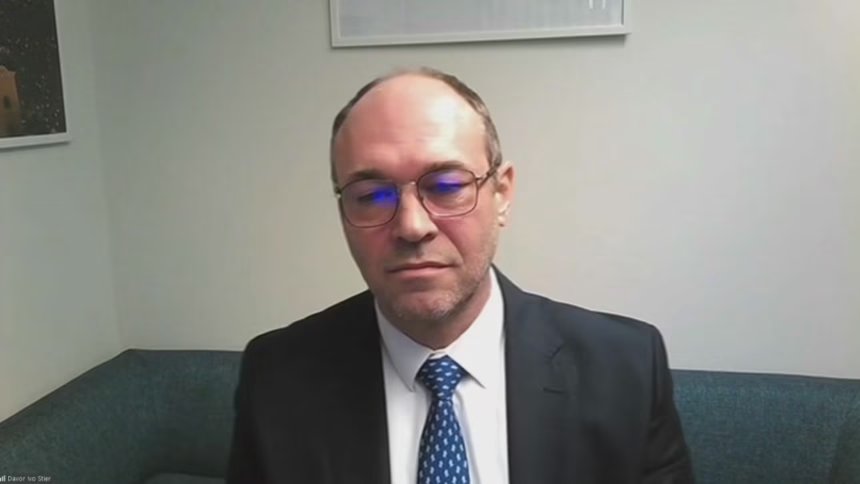
Member of the European Parliament Davor Ivo Štir stated that the recent visit of a European Parliament delegation to Serbia revealed serious shortcomings, raising concerns about the country’s commitment to European values and democratic standards.
Speaking to N1 television, Štir, a member of the European People’s Party (EPP), said the delegation visited Serbia as a country that has declared its intention to join the European Union, but noted that the reality on the ground showed numerous deficits.
“We were certainly in a country that says it wants to move towards the European Union and adopt European values, but where we observed a series of deficiencies. The situation is truly serious,” Štir said.
He emphasized that the delegation’s goal was to listen directly to all relevant stakeholders, rejecting claims that the mission arrived with preconceived positions.
The delegation held meetings with representatives of the ruling coalition, opposition parties, civil society organizations, independent media, academia, and student groups.
“The purpose of this visit was to understand the situation first-hand and to support Serbia’s European perspective, which is in the interest of both Serbia and the EU,” Štir explained.
However, he noted that EU membership does not currently appear to be a political priority in Serbia, adding that although government representatives claim progress on EU criteria, there is no willingness to abandon a multi-vector foreign policy.
According to Štir, discussions with opposition parties and students showed that the primary concerns are rule of law, institutional independence, and democratic governance, rather than EU accession itself — issues he described as fundamental prerequisites for European integration.
Štir also criticized the decision of President Aleksandar Vučić and Parliament Speaker Ana Brnabić to refuse meetings with the EP delegation, warning that such actions narrow the space for political dialogue.
“Countries seeking EU membership are expected to broaden dialogue, not restrict it,” he stressed, adding that respect for EU institutions, including the European Parliament and its delegations, is essential.
He pointed out what he called a paradox — that public support for Serbia’s EU membership is currently higher in Croatia than in Serbia itself, warning that poor communication further undermines trust.
Finally, Štir confirmed that the review of the Serbian Progressive Party’s (SNS) status within the EPP is ongoing, noting that fact-finding discussions are underway and that a formal decision will be made by the EPP Presidency. He added that Serbia’s political alignment with parties outside the EPP framework, such as Hungary’s Fidesz, has been registered as an additional concern.