Concerns over a potential arms race in the Western Balkans were at the center of a discussion on the “Ura” program of Radio Free Europe/Radio Liberty’s Balkan Service, where security analysts Nikola Lunić and Igor Tabak examined recent military developments in the region.
The debate focused on statements by Serbian President Aleksandar Vučić, Croatia’s military modernization within NATO, sources of arms procurement, and weapons Serbia has admitted to acquiring secretly.
Serbia’s Military Ambitions Under Scrutiny
President Aleksandar Vučić recently stated that Serbia aims to double its military capabilities within a year and a half. However, security experts argue that this claim is largely political rather than realistic.
Nikola Lunić, a security analyst from Belgrade, stressed that such an objective is unachievable under current conditions.
“Serbia already allocates around 2.5% of its GDP to the military, and it is difficult to go beyond that. Despite major investments, the real military power of countries in the region is actually declining,” Lunić said.
Multivector Arms Procurement and Hidden Purchases
For years, Serbia has pursued what authorities describe as a “multivector” approach to arms procurement, sourcing weapons from Russia and China, but also from Western countries, particularly France.
While this provides political flexibility, experts warn it creates serious technical and logistical challenges.
“Mixing Eastern and Western technologies makes system maintenance extremely expensive. The example of Ukraine shows this can even be counterproductive,” Lunić noted.
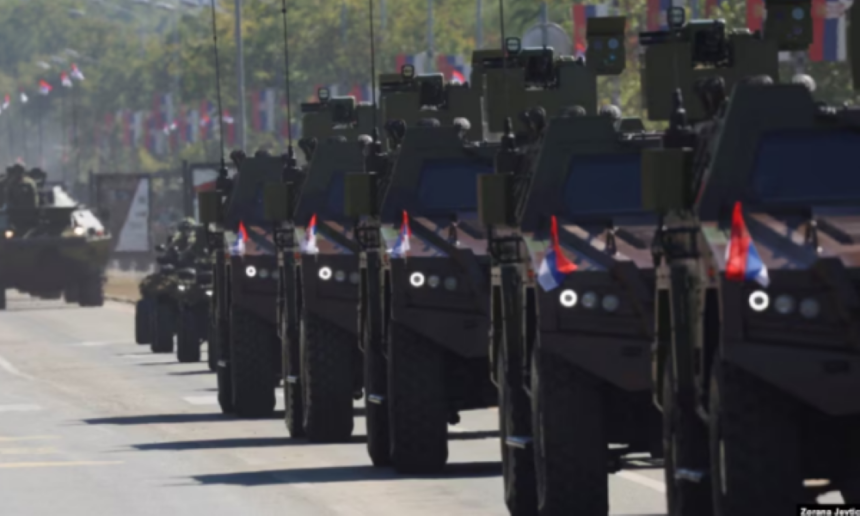
Vučić has acknowledged that part of Serbia’s military equipment was purchased in secrecy. According to Lunić, the public only became aware of some systems during a military parade in Belgrade last September.
These reportedly included Russian electronic warfare systems such as ‘Krasukha’ and ‘Moskva’, likely delivered via indirect air routes, as well as advanced systems from Israel, revealed only days before the parade.
Lunić added that military cooperation with Israel has intensified, involving both arms imports and exports, potentially influencing Serbia’s foreign policy orientation.
Military Agreements and Alliance Concerns
The Defense Cooperation Declaration signed by Kosovo, Albania, and Croatia in March 2025, followed by Serbia’s military cooperation agreement with Hungary, sparked debate over whether the region is forming new military blocs.
Experts remain skeptical. Lunić emphasized that these documents do not constitute real alliances.
“The declaration explicitly states that it does not create new international or intergovernmental obligations. These are primarily political tools for domestic audiences,” he explained.
Igor Tabak, a military analyst from Zagreb, argued that defense cooperation among neighbors is standard practice.
“More concerning than signing new agreements is the failure to implement existing ones,” Tabak said, referring to unimplemented agreements between Croatia and Serbia.
NATO Framework vs. Military Neutrality
Unlike Serbia, Croatia operates fully within the NATO framework, which—under U.S. pressure—has decided to significantly increase defense spending.
- Initial target: 2% of GDP
- Later raised to 3.5% for direct defense
- In some cases, total security spending may reach up to 5% of GDP
According to Tabak, this does not signal a Balkan arms race, but rather a broader strategic shift within the Euro-Atlantic alliance.
“This is a slow but irreversible process agreed upon by NATO political leadership,” he stressed.
Croatia’s long-term alignment with Western equipment and NATO standards, Tabak added, significantly reduces logistical costs, which are among the most expensive aspects of any military system.
Mandatory Military Service and Regional Stability
Croatia recently decided to reintroduce mandatory military service, citing developments in Ukraine, personnel shortages, and EU security debates. However, Tabak described the model as outdated.
In Serbia, discussions about restoring compulsory service continue, but Lunić doubts it will happen before early elections expected later this year.
“Introducing mandatory service before elections would provoke serious backlash, especially among young people. Military training has never been education—it has always been just training,” Lunić said.
No Real Military Rivalry, Experts Say
According to analysts, there is no genuine military rivalry between Serbia and Croatia. Croatia is firmly embedded within NATO and the EU, while Serbia maintains a policy of military neutrality, which Lunić described as increasingly unstable.
“Virtual neutrality in these circumstances can become an existential risk. Serbia must clarify its orientation and normalize relations with Kosovo—this is also crucial for the EU,” Lunić concluded.