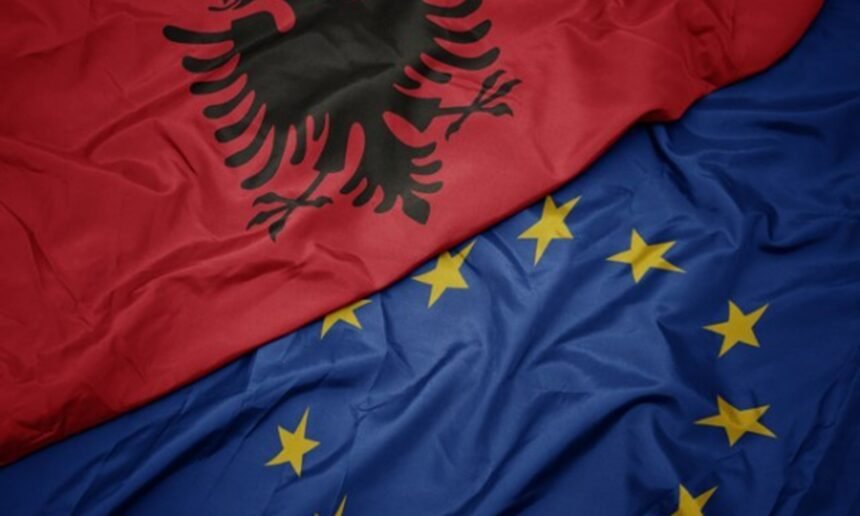
Montenegro and Albania are first in line for EU membership among all candidate countries.
Their accession is considered a realistic prospect and not the result of EU favoritism, according to an analysis presented in recent days at a forum organized by the Vienna Institute for International Economic Studies (wiiw).
Participants noted that despite its favorable position, Albania faces a concerning concentration of power, while Serbian President Aleksandar Vučić could still generate instability in Montenegro. As a result, a scenario of partial EU membership is seen as more likely over the next three years.
Under this scenario, partial membership would mean that a candidate country joins the European Union’s economic and institutional framework without yet becoming a full member with complete political rights, including voting rights.
In practical terms, Albania would gain access to the EU’s internal market, be included in its economic policies, receive development funds, and implement EU legislation. However, it would not have voting rights in the EU Council, would not appoint a European Commissioner, and would not enjoy full representation in the European Parliament.
According to this scenario, Montenegro and Albania would be integrated into the EU economically and regulatorily within the next three years, but would remain without full political membership for many more years.
Analysts in Vienna argue that this model aims to overcome the current paradox of EU enlargement, in which candidate countries are required to implement a large share of EU rules while failing to reap economic benefits from the process for many years.
Under this form of membership, Albanian companies would gain real access to the EU single market, free of tariffs and non-tariff barriers. Foreign investors would treat the country as part of the EU’s economic space, and Albania’s economy would integrate directly into Europe’s production and service value chains.
At the same time, Albania would be able to access significantly larger funds than those currently available through pre-accession instruments, benefiting from structural, agricultural, and infrastructure funds that are currently reserved only for EU member states.
From the European Union’s perspective, this approach is seen as a way to stabilize the Western Balkans, firmly anchor the region to the European economy, and reduce the influence of other geopolitical actors—without immediately taking politically sensitive decisions on full membership.
From the candidate countries’ standpoint, partial membership is viewed as a way to avoid losing yet another decade in waiting, while populations emigrate and economies remain isolated from the world’s largest market.
Regarding the free movement of people, partial EU membership would imply that citizens of a country such as Albania would gain broader rights to work, study, and reside in EU countries, though still subject to certain limitations. The model under discussion resembles Norway’s or Switzerland’s arrangements in some areas, but would be more limited in scope.
Vienna-based analysts emphasized that the Western Balkans have been waiting in line for a long time, noting that gains from EU economic convergence have been rather modest. Moreover, strict fiscal policies across the region limit policy maneuverability.
Unlike Ukraine, the Western Balkans have performed relatively well in attracting foreign direct investment, and their overall outlook is positive, with fairly stable macroeconomic conditions. The most problematic issue remains a lack of competitiveness, combined with an urgent need for a stronger and more effective industrial policy.