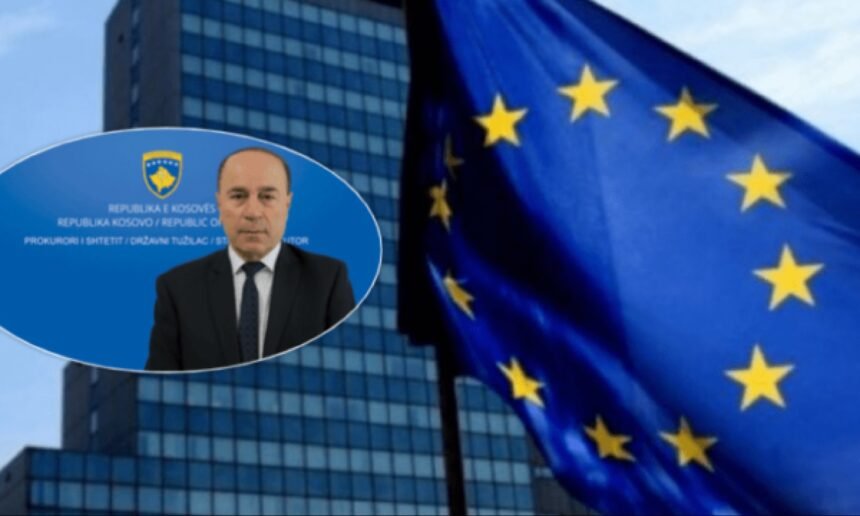
Following a letter sent on Monday by EU Ambassador to Kosovo, Aivo Orav, to the Acting Chief Prosecutor Agron Qalaj, expressing serious concern that the new composition of the Kosovo Prosecutorial Council (KPC) did not take office during its constitutive meeting held on 20 January 2026, Qalaj replied, stating that the procedural conduct of the meeting was fully guided by legal requirements governing quorum, voting, and formal decision-making.
In his letter, Qalaj emphasized that the certification issue is subject to ongoing judicial procedures, which, he noted, have been respected. He further reaffirmed his commitment to reform within the KPC, according to “Betimi për Drejtësi.”
Legal and Procedural Compliance
Qalaj stressed that all actions taken in his institutional capacity were strictly guided by the existing legal and procedural framework, as well as the clear and limited competencies assigned to the Acting Chief Prosecutor during the constitutive phase of the KPC.
“In my institutional capacity, I wish to reiterate that all actions undertaken to date have been strictly guided by the applicable legal and procedural framework, as well as by the clear and limited competencies assigned to the Acting Chief Prosecutor during the constitutive phase of the Kosovo Prosecutorial Council,” he wrote.
He added that his approach has consistently focused on ensuring procedural legality, institutional stability, and the protection of the Council’s credibility.
“My approach has consistently been oriented toward ensuring procedural legality, institutional stability, and safeguarding the Council’s credibility. Regarding the constitutive meeting, the procedural conduct followed the legal requirements governing quorum, voting, and formal decision-making,” Qalaj stated.
Role in the Council and Decision-Making
Qalaj clarified that institutional decisions were taken by the Council as a collegial body, and that his role was strictly procedural.
“My role has been strictly procedural, to ensure that the process was conducted in accordance with the law, and that institutional decisions were made exclusively by the Council as a collegial body. Regarding additional proposals during the first meeting, including certification, a transparent procedural approach was followed, allowing presentation and discussion within the collegial forum, while final decision-making authority remained fully with the Council in line with procedural rules,” he said.
He also noted that some expectations reflected in Ambassador Orav’s letter had been previously expressed by certain Council members, but from a procedural and legal standpoint, these were not consistent with the constitutive nature of this phase, and actions must follow clearly defined legal and regulatory limits.
“For this reason, my approach has been guided exclusively by the obligation to respect these legal and procedural boundaries,” Qalaj emphasized.
Ongoing Judicial Procedures
Qalaj highlighted that the certification matter remains subject to judicial procedures, including a temporary protective measure issued by the competent court.
“It is important to note that the certification issue is currently subject to ongoing judicial procedures, with a temporary protective measure imposed by the competent court. Additionally, the regulations governing the election of the KPC’s prosecutorial member are also under separate judicial review. Within this institutional context, compliance with judicial procedures and due legal diligence has necessarily been integral to my approach. I fully acknowledge and share your emphasis on the necessity of institutional measures to ensure the Council functions properly,” he wrote.
Commitment to Reform and Cooperation
Qalaj reaffirmed his commitment to institutional continuity, legal certainty, and institutional coherence, while remaining open to structured institutional dialogue and constructive cooperation with international partners.
“I remain fully committed to the reform process within the Kosovo Prosecutorial Council and to advancing standards of transparency, accountability, and institutional governance, in line with best European practices and shared strategic objectives. I value the EU’s ongoing support and remain open to structured institutional dialogue and further cooperation in the interest of strengthening the Council’s functionality, credibility, and stability,” Qalaj wrote.
Context of the EU Letter
Ambassador Orav had sent a letter on 26 January, calling it disappointing that the new KPC composition failed to take office during the constitutive meeting of 20 January 2026. The EU emphasized that this failure undermined the Council’s legitimacy and the ongoing pro-reform efforts in the prosecutorial system, as the Council was intended to mark a key milestone in reform implementation.
The EU expressed concerns that procedural irregularities had delayed reforms, reduced the Council’s credibility, and questioned the Council’s commitment to legitimate, transparent, and fair leadership.
Separately, the Kosovo Justice Institute (IKD), in a statement on 21 January 2026, expressed deep concern that Qalaj’s actions are directly hindering the KPC reform process, noting that he continues to rely on outdated corporate-style governance approaches and unsubstantiated legal interpretations to delay the Council’s functionalization, maintaining a corporatist mindset within the prosecutorial system.