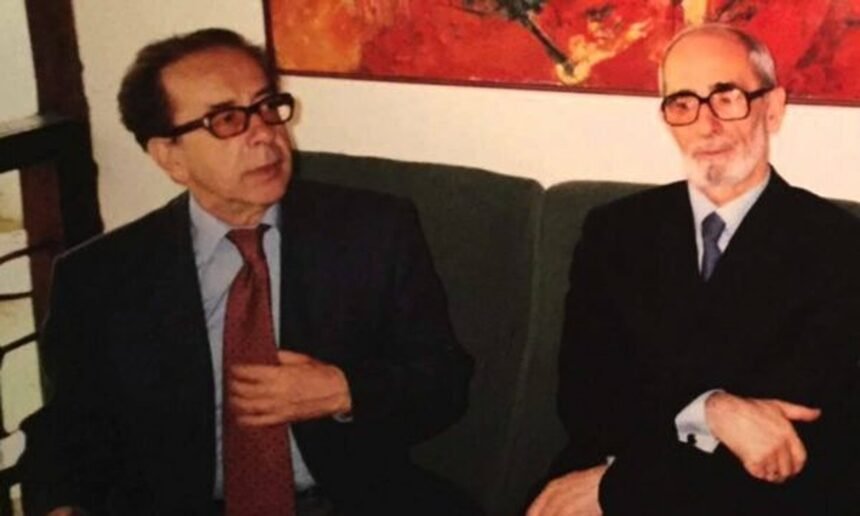
On the 90th anniversary of the birth of the great Albanian writer Ismail Kadare, academician and writer Rexhep Qosja published a reflective and personal commemorative text, in which he also praised Kadare’s literary work and expressed his intellectual admiration for the author who passed away in 2024.
In his writing, Qosja describes Kadare as one of the most representative figures in Albanian literature—a writer who brought the historical, mythical, and ethical experience of Albanians into European and global literature, giving the Albanian language a universal dimension and a distinct voice to Albanian culture.
Reflecting on the fact that Qosja himself turns 90 this year, he expresses nostalgic regret that they did not have the chance to celebrate this milestone together, while emphasizing that their dialogue continues through their works.
Excerpt from Rexhep Qosja’s full text, published on his Facebook page:
Today, January 28, 2026, marks the 90th anniversary of the birth of the great Albanian writer Ismail Kadare. This date is both a birthday of an extraordinary creator and a day of remembrance, because Kadare is no longer physically with us. He passed away in 2024, leaving behind a body of work that transcends its own time and the boundaries of its language.
Kadare is one of the most representative names in Albanian literature. He is the writer who brought the historical, mythical, and ethical experience of Albanians into the broader map of European and world literature. Through his novels, essays, poetry, and journalism, he gave the Albanian language a universal dimension and gave Albanian culture a recognizable, respected, and heard voice.
Kadare and I became acquainted and close as early as the 1970s. We were friends, interlocutors, readers, and critics of one another. We wrote about each other’s works and exchanged mutual evaluations.
Both of us, each on our own side of the divide that separated us, faced different, often harsh and unfair fates. Historical, political, and social circumstances, which we did not choose but were imposed upon us, tested our moral and intellectual resolve, requiring not only resilience but also difficult personal decisions.
Kadare’s political asylum in France in 1990 was misunderstood by many who did not appreciate the moral weight of that decision. In some public statements, especially in a declaration to the Voice of America, I explained that this act was not a flight from his homeland, but a refusal of a system that had imposed invisible yet rigid limits on free thought.
Kadare did not leave to save himself, but to save his work and its freedom. His asylum was both an intellectual and ethical act: the choice of free expression in the face of the silent violence of dictatorship. History has shown that a writer who seeks freedom does not abandon his nation; he serves it in the highest possible way.
This stance I would soon verify by visiting Kadare at his home in Paris.
But, as often happens among thoughtful intellectuals, we had disagreements and polemics. Our most notable debate was about Albanian identity. There were different opinions, different arguments, different perspectives on the same fundamental issue. These disagreements were not personal; they were intellectual and cultural. Yet, as sometimes happens in life, they affected our personal relationship. Our friendship waned, and unfortunately, our paths no longer crossed.
Today, in remembering Kadare on his 90th birthday, I feel compelled to emphasize something important: his greatness as a writer and his historical significance for Albanian culture transcend any disagreement. Literature is not measured by personal agreements or disputes, but by the depth of thought, the power of language, and its long-term impact.
Kadare was and remains above all a writer of his nation. He loved Albania not declaratively, but creatively. He loved it by transforming Albanian history, drama, and spirit into great literature.
This June, I too will turn 90. It is impossible not to think how meaningful and human it would have been to raise a glass together for this rare age, for these two lives spent among books, debates, and love for the Albanian language and culture. Perhaps this remains a personal longing, but not a cultural one, because our dialogue continues through our works.
Kadare today does not need praise on occasion. He needs reading, rereading, and understanding. His work must be treated with scholarly seriousness and cultural sensitivity. Future generations may interpret it differently, but they will always read it. And they will admire it.
His passing, I repeat, is only physical. His name, work, and thought remain universal. On this 90th birthday, Ismail Kadare remains a major historical figure of Albanian culture, one of those who will continue to challenge, disturb, and inspire us.
I remember you with longing and respect, my friend, Ismail Kadare. Your eternity in my soul and mind is eternal. It is magnificent eternity: past, present, and future.
Rexhep Qosja
Pristina, 28.1.2026