The Constitutional Court has issued a decision regarding the request submitted by the Serbian List concerning the election of the Deputy Speaker of the Assembly from the Serbian community.
The Court ruled that the Deputy Speaker from the Serbian community belongs to the majority of deputies from that community. It also rejected the Serbian List’s request for a temporary measure, stating that “in the circumstances of this specific case, it would have no retroactive effect.”
The Court’s decision stated:
- The request was declared admissible with 6 votes in favor and 1 against.
- It was determined, by 5 votes to 2, that the Assembly of Kosovo’s Decision [Nr.09-V-071] of 10 October 2025, regarding the election of the Deputy Speaker from the Serbian community, does not comply with Paragraph 4 of Article 67 [Election of the Chairperson and Deputy Speakers] of the Constitution in relation to Subparagraph 1 of Paragraph 6 and Paragraph 7 of Article 12 [Election of Deputy Speakers] of the Rules of Procedure of the Assembly of Kosovo.
- The Court further noted, with 5 votes to 2, that based on the principle of legal certainty, this judgment does not have retroactive effect.
- The request for a temporary measure was unanimously rejected.
The ruling emphasizes that this standard is crucial for the constitutional protection of the rights of non-majority communities.
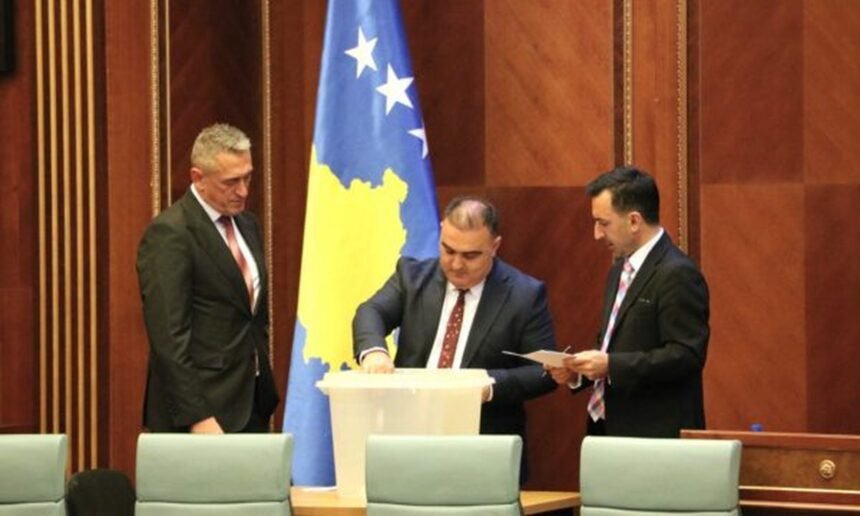
The Court reviewed the procedural history, noting that multiple proposed candidates from the Serbian community failed to obtain the necessary majority votes in successive rounds. Ultimately, the Assembly’s procedure allowed the final candidate, Nenad Rašić, to be voted upon via the established lottery mechanism. Rašić received 71 votes in favor, 9 against, and 24 abstentions.
The Court concluded that the Serbian community’s majority deputies had exercised their right to propose Deputy Speaker candidates and that the election of Nenad Rašić did not originate as a proposal from the majority of Serbian deputies. Mechanisms intended to unblock the election were therefore applied in a manner inconsistent with their intended purpose.
Finally, based on the principle of legal certainty, the Court clarified that this decision does not have retroactive effect.