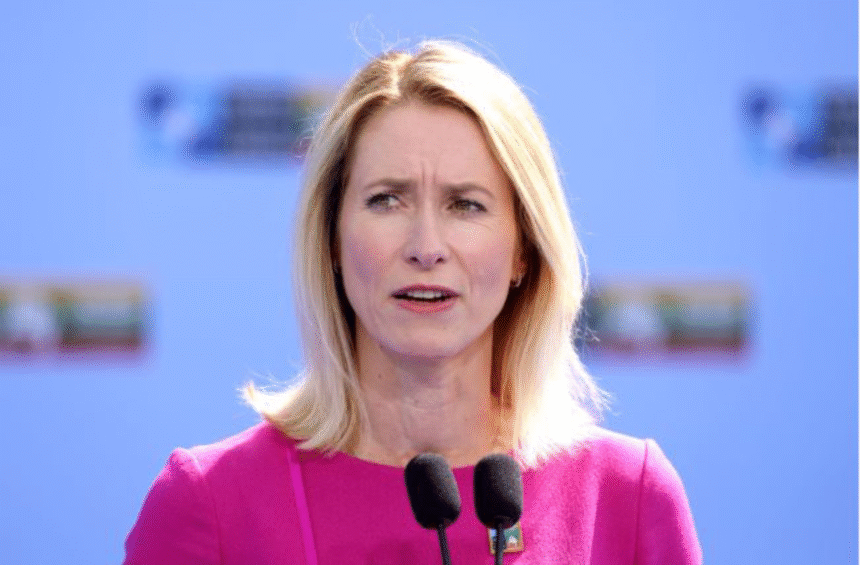
Europe must take urgent steps to strengthen its own defense and make NATO more “European” in order to preserve its strength, warned EU High Representative for Foreign Affairs and Security Policy Kaja Kallas, amid growing strains in transatlantic relations.
Speaking at a defense conference, Kallas said the United States will remain Europe’s partner and ally, but stressed that no major power in history has entrusted its survival to others and endured.
“Europe cannot rely indefinitely on others for its security,” Kallas said, adding that the continent must assume greater responsibility for its own defense.
Transatlantic Tensions and Strategic Shift
Relations between Europe and the United States have been shaken at their core, particularly after U.S. President Donald Trump threatened to take control of Greenland, a semi-autonomous Danish territory. The episode highlighted what Kallas described as a “tectonic shift” in US-European relations.
According to Kallas, Europe is no longer Washington’s primary center of gravity, and this shift is structural rather than temporary. She urged European nations to move away from national thinking and act collectively as Europeans.
Debate Within NATO
Kallas’s remarks come amid an intense debate within NATO. NATO Secretary General Mark Rutte sparked controversy after stating that European lawmakers should “keep dreaming” if they believe Europe can defend itself without the United States.
French Foreign Minister Jean-Noël Barrot strongly rejected that view, responding:
“Europeans can and must take control of their own security. Even the United States agrees. This is the European pillar of NATO.”
Kallas echoed this position, emphasizing that the 23 countries that are members of both the EU and NATO carry a special responsibility to synchronize their defense efforts with the Alliance and demonstrate how a distinct European pillar can add value.
Defense Spending and US Expectations
Last year, under pressure from President Trump, NATO members pledged to raise total defense spending to 5% of GDP by 2035, with part of that funding potentially allocated to national infrastructure.
However, Rutte warned that if Europe truly wanted to defend itself independently, it would need to spend up to 10% of GDP and develop its own nuclear deterrent, arguing that distancing from Washington would mean losing the ultimate guarantor of European freedom: the US nuclear umbrella.
Europe Urged to Wake Up
At the same conference in Brussels, EU Defense Commissioner Andrius Kubilius said the United States now expects Europeans to take responsibility for their own defense, as Washington is likely to reduce its military presence on the continent.
“Europe is a giant, but a sleeping giant,” Kubilius said. “We must build our independence very quickly. Independence in defense: no delays, no excuses.”
NATO, Russia, and Ukraine
Founded in 1949, NATO’s core mission was to safeguard its members against the Soviet Union, which collapsed in 1991. Russian President Vladimir Putin has long accused NATO of eastward expansion and has justified Russia’s full-scale invasion of Ukraine in 2022 as a response to that perceived threat.
Ironically, Russia’s increasingly aggressive posture has prompted Sweden and Finland, both EU members, to join NATO since the invasion.
The Kremlin continues to insist that Ukraine must be barred from NATO membership as part of any future peace agreement. While Ukraine’s constitution enshrines its ambition to join both the EU and NATO, analysts consider its near-term NATO accession unlikely.