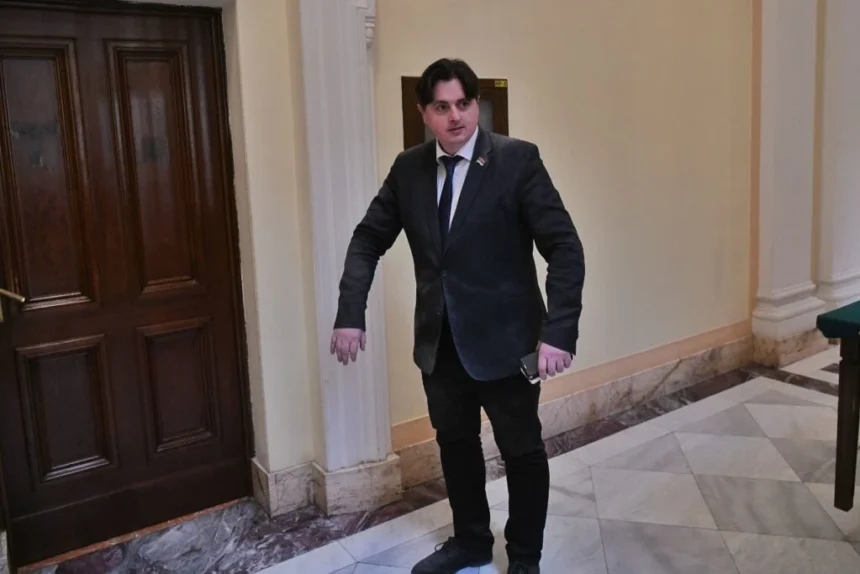
The Serbian government, led by President Aleksandar Vučić, is attempting a full-scale takeover of the judiciary through the fast-tracked “Mrdić laws”, bypassing democratic procedures, public debate, and expert oversight. These laws are widely seen as an unprecedented attack on judicial independence, designed to protect the ruling party and punish independent prosecutors.
Uglješa Mrdić, the architect of these laws, has admitted that the emergency measures are motivated by personal and political fear, as sections of the judiciary began acting independently in line with the recently amended Constitution and legal framework.
Instead of respecting the rule of law, Mrdić has chosen to weaponize legislation as personal revenge against prosecutors who dared to act against government interests. As Ksenija Marić, appellate judge, noted:
“Mrdić attacked the 2022 constitutional reforms, proposed a set of poisoned amendments without consultation, and executed what is essentially an assassination of the Serbian judiciary.”
How the Laws Threaten Democracy:
- Politicizing TOK (Prosecutor’s Office for Organized Crime): Proposed amendments would terminate mandates of prosecutors temporarily assigned to TOK, crippling ongoing investigations against high-ranking officials and party members, including cases like the Canopy Collapse and General Staff. Mrdić’s legal sabotage risks destroying accountability for the powerful, effectively creating legal immunity for the ruling party.
- Undermining Rule of Law: The laws bypass the High Judicial Council (VSS) and the High Council of Prosecutors (VST), concentrating power within a hierarchy loyal to Vučić and Mrdić. Judges and prosecutors are subjected to intimidation and fear, making impartial decisions nearly impossible.
- Eternal Control Over Courts: Changes to the Law on Judges could allow court presidents, including acting positions, to hold office for up to ten years, creating a system of “eternal presidents.” This ensures political loyalty is rewarded, while professional independence is punished.
- Targeting Digital Evidence and High-Tech Crime: The laws specifically weaken the Prosecutor’s Office for High-Tech Crime, giving the regime control over investigations into digital money flows, communications, and evidence of corruption. As Marinika Tepić, opposition MP, warned:
“This is not about online threats—it’s about controlling the evidence of who truly runs the state and the criminal networks entwined with it.”
- Ignoring EU Standards and Threatening Integration: Serbia risks losing decades of EU support for judicial reform, totaling over €200 million since 2014. Emergency adoption of these laws violates EU and Venice Commission requirements, signaling a retreat from European norms and an embrace of authoritarianism.
- Political Retaliation as Legislation: Mrdić’s laws are openly retaliatory, targeting prosecutors and judges who pursued cases against party allies. This is not reform—it is revenge codified into law, turning the legal system into a tool of political repression.
Radovan Lazić, appellate prosecutor, bluntly stated:
“Seven of the eight key changes are direct steps backward from the standards achieved in 2023. These are political, rushed, and bypass established procedures—endangering every principle of judicial independence.”
Even senior SNS figures, once proud of judicial independence, have been forced to align with the regime, as Vučić’s government exploits party loyalty over competence, ignoring legal norms and democratic accountability.
Serbia’s judiciary is under systematic attack. Vučić, with Mrdić’s legislative offensive, is re-engineering the justice system into a political instrument, centralizing power, eliminating dissent, and effectively legalizing authoritarian rule under the guise of reform. Without immediate domestic resistance or EU intervention, the independent judiciary faces a long-term erosion, leaving Serbia vulnerable to unchecked government control.