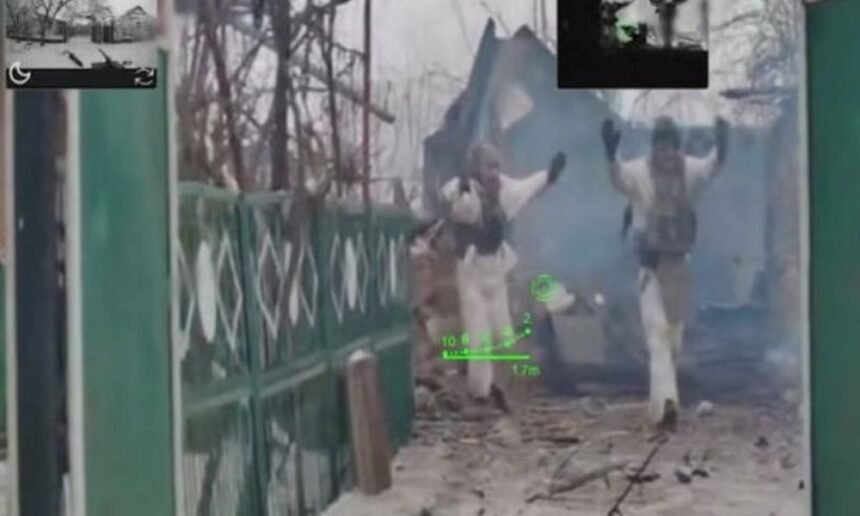
For the first time in documented military history, Russian soldiers have surrendered not to Ukrainian infantry, but to an autonomous ground combat robot operating on the front line.
The incident involved the Ukrainian AI-powered reconnaissance and strike system Droid TW‑7.62, built on the NUMO modular platform, which successfully captured three Russian soldiers without any direct involvement of Ukrainian ground troops.
The video footage, released by DevDroid, the manufacturer of the system, highlights a new and unprecedented reality of modern warfare, where autonomous systems are increasingly replacing human presence at the most dangerous points of the battlefield.
Robot Forces Surrender Without Infantry Support
The video shows Russian soldiers approaching the robotic platform one by one, laying down their weapons, removing their equipment, and lying face down on the ground next to the system—fully complying with its commands without any direct human contact.
DevDroid emphasized the symbolic and strategic significance of the event, stating:
“This is what modern warfare looks like. Robots are on the front line. Humans are kept safe.”
Droid TW‑7.62: Machine Gun, Artificial Intelligence, and Autonomous Targeting
The Droid TW‑7.62 is a reconnaissance and strike robotic system equipped with a KT‑7.62 (PKT) machine gun and a ballistic computer, allowing for high-precision targeting and effective fire control.
Its core advantage lies in artificial intelligence, which enables the system to:
- Autonomously detect targets
- Lock onto identified targets
- Track objects in real time
These capabilities significantly reduce operator workload while enhancing the survivability of combat units.
NUMO Platform and the Future of Ukrainian Ground Combat Robots
Built on the NUMO modular platform, the system can be adapted for a wide range of combat missions. Droid TW‑7.62 is capable of operating in challenging terrain and complex battlefield conditions, and can be integrated with additional sensors, including:
- Night vision systems
- Thermal imaging cameras
- Low-visibility and adverse-weather operation systems
Ukrainian forces have already demonstrated positive combat experience with similar systems. Previously, the Droid TW‑12.7, deployed by the 3rd Separate Assault Brigade, completely replaced an infantry position, holding it for over six weeks under continuous combat conditions.
Russian forces failed to break through the defenses under sustained autonomous fire, marking one of the earliest real-world proofs of the effectiveness of ground combat robots in active warfare.