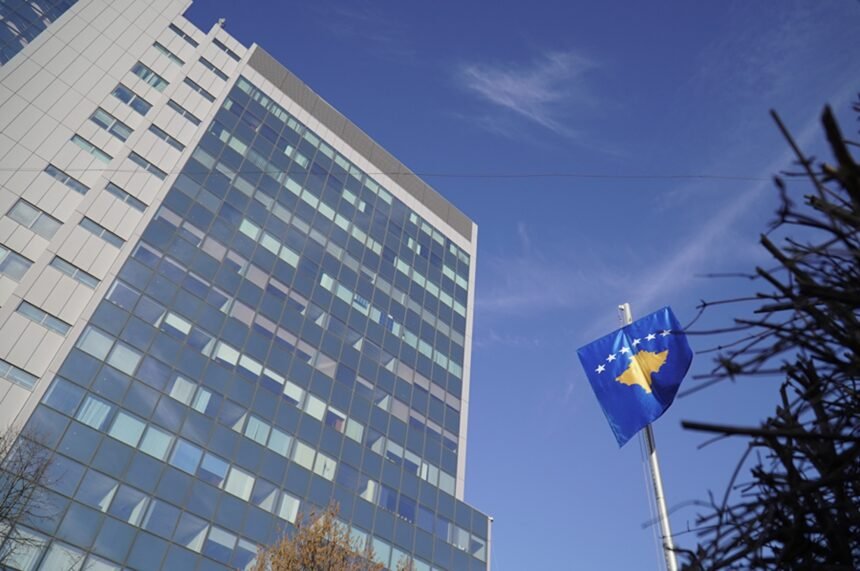
The Government of Kosovo has established a working group consisting of officials from state institutions, including legal experts and others, to address issues arising from the implementation of the Law on Foreigners and the Law on Vehicles, confirmed Kosovo’s Acting Government Spokesperson, Përparim Kryeziu.
“The role and responsibility of this group is to clarify the requirements outlined by the laws, as well as the state’s engagement with the entities affected by these laws, with the aim of facilitating their full implementation,” he said, without specifying the members of the working group.
Kryeziu emphasized that representatives of the international community in Kosovo have already been informed about the group and “have held initial meetings.”
Earlier, the Serbian List, the largest Serbian party in Kosovo backed by Belgrade, stated that it had held dozens of meetings with international representatives regarding these issues, noting that the internationals had decided to “form a separate team of experts to address this problem.”
REL reached out to the European Union and QUINT countries to ask whether they participated in forming the expert team, but they did not respond.
The first phase of full implementation of the Law on Foreigners and the Law on Vehicles began on January 16 and will last until March 15. During this period, an information campaign for citizens regarding both laws is planned.
The implementation of these rules will affect members of the Serbian community living in Kosovo, who so far have driven vehicles with license plates from cities in Serbia or without Kosovo-issued documents.
On January 23, a group of Serbian non-governmental organizations announced that, regarding the announcement of full implementation of the Law on Foreigners and the Law on Vehicles, they had met with representatives of diplomatic missions in Kosovo and invited them to take a greater role in this matter.
The organizations New Social Initiative, Center for Affirmative Social Action, Aktiv, and the Institute for Territorial Economic Development called on the international community to insist on “broad and inclusive consultations with the Serbian community, including relevant political representatives, civil society, and the academic community, as a prerequisite for any further steps regarding these legal frameworks.”
Meanwhile, Nenad Rashiq, leader of the party “For Freedom, Justice and Survival,” urged all political actors in Kosovo, especially the Serbian List, to “take responsibility and actively participate in drafting legal-technical proposals” to ensure a smooth transition in implementing the Law on Foreigners and the Law on Vehicles.
Rashiq emphasized that it is the responsibility of politicians to find ways to “adapt efficiently and rationally to their implementation.”
In response, the Serbian List stated that Rashiq “participates in Albin Kurti’s government without any legitimacy or support from the Serbian people and votes for all measures aimed against Serbs in Kosovo and Metohija.”
Rashiq previously served as a minister in Albin Kurti’s government after the Serbian List left Kosovo’s institutions in November 2022. In the latest parliamentary elections, the Serbian List won nine of the ten seats reserved for the Serbian community in the Assembly, while Rashiq won one.
Acting Prime Minister of Kosovo, Albin Kurti, on January 16, stated that alongside implementing the Law on Foreigners and the Law on Vehicles, it is necessary to integrate Serbian health and education institutions, adding that the process will be carried out in coordination with the European Union and will take into account the concerns of non-majority communities.
Serbian community educational and health institutions in Kosovo operate within the Serbian system and are almost the only ones that Prishtina has not closed in the past two years as part of efforts to shut down parallel Serbian institutions, which are considered illegal by the Kosovo authorities.
Staff at these institutions, particularly professors and students at the University of North Mitrovica, may face difficulties once full implementation of the Law on Foreigners begins, because according to the Ministry of Internal Affairs directive published on January 16, anyone without Kosovo documents must possess a work permit or license, which is issued by the Kosovo Employment Agency.
In practice, this means that Serbian system educational and health institutions must obtain a license from Kosovo institutions.
The Ministry of Internal Affairs directive also specifies that for purposes such as study, family reunification, humanitarian reasons, scientific research, and other legally prescribed circumstances, possession of a temporary residence permit and fulfillment of other legal conditions are required, depending on the purpose of stay.
Additionally, foreign nationals in Kosovo may stay for up to 90 days, and any longer stay requires submitting a residence permit application.
Those who violate these rules may face legally prescribed measures, including revocation of residence permits, fines, deportation, or entry bans in Kosovo.