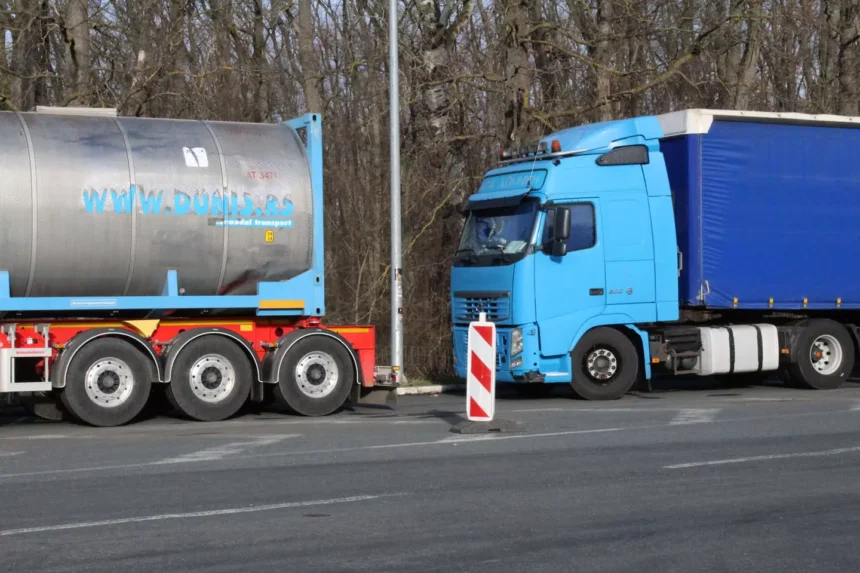
Truck drivers from Serbia and Bosnia and Herzegovina have suspended blockades at border crossings, following a proposal by the European Commission to consider special visa arrangements for professional freight drivers operating on international routes.
The drivers had blocked cargo terminals at border crossings for five consecutive days, disrupting freight traffic across the Western Balkans–EU borders.
According to Neđo Mandić, president of the International Transport Business Association, the decision to lift the blockades was made after the European Commission signaled readiness to address the drivers’ long-standing concerns.
“We made this decision after yesterday’s announcement. What we received represents a sufficiently good path forward and meets our key demands. Additionally, we were promised that a working group meeting will take place in Brussels on Tuesday, February 3,” Mandić told the media.
What the European Commission Is Considering
According to reports by N1, the European Commission is examining a solution that would introduce an extended short-stay regime for truck drivers from the Western Balkans.
Under the current Schengen rules, drivers are subject to the 90 days within 180 days limit, even though their time is counted regardless of whether they remain in the EU for several hours or only a few minutes per day.
The proposed measure — currently under discussion as part of the European Commission’s new Asylum and Migration Strategy — would ease these restrictions by introducing a separate stay calculation or special visa category for professional drivers. However, specific limits have not yet been formally defined, as discussions remain ongoing.
Five Days of Blockades
Truck drivers from Serbia, Bosnia and Herzegovina, North Macedonia, and Montenegro began blocking freight terminals on January 26, protesting new EU regulations and the upcoming electronic entry-exit system for the Schengen Area, which they argue would severely hinder their ability to work.
During the protests, more than 20 border crossings were blocked, with only essential goods such as medicines, medical equipment, live animals, and ammunition allowed to pass, according to drivers.
Regional Coordination and Gradual Suspension
Transport associations from Montenegro and North Macedonia suspended their blockades a day earlier, on January 29, after reaching agreements with their respective governments and following the European Commission’s announcement of a new policy approach.
Drivers from Serbia and Bosnia continued protests for an additional day before ultimately joining the coordinated suspension of blockades.