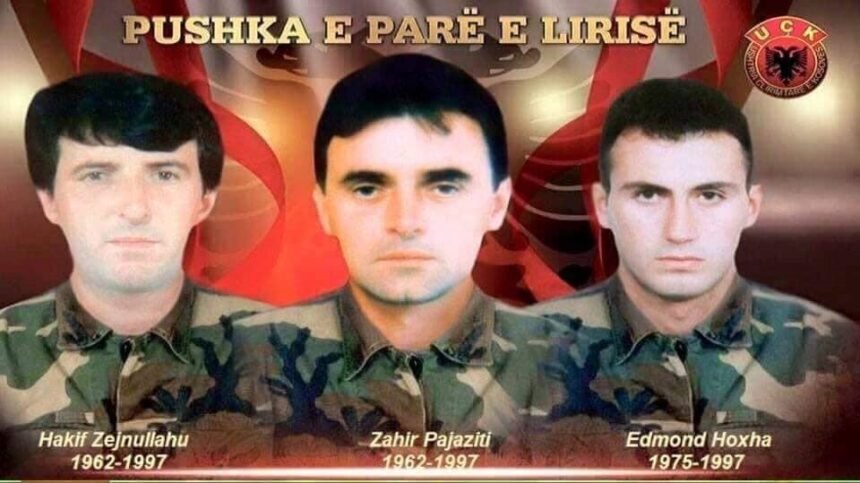
Today marks 29 years since the heroic fall of Zahir Pajaziti, Hakif Zejnullahu, and Edmond Hoxha, three of the earliest and most important strategists of the Kosovo Liberation Army (KLA).
On January 31, 1997, one of the first major armed confrontations of the KLA took place. The three fighters were traveling from Prishtina toward Vushtrri when their group was discovered by Serbian security forces, who had set an ambush in the village of Pestovë. Following a fierce confrontation, all three fell heroically in battle.
Zahir Pajaziti began his military and organizational activities in the early 1990s, during a period of widespread resistance in Kosovo. After the general strikes of September 3, 1990, he played a key role in establishing underground security networks, particularly in the Orllan region, where the Guerrilla Unit Headquarters was formed.
In 1991, Pajaziti traveled to Albania for military training, and upon his return to Kosovo in 1992, he was forced into illegality after his group was exposed. Despite these risks, he contributed significantly to the supply of weapons and the expansion of resistance structures.
By 1994, Pajaziti had become active across different regions of Kosovo and emerged as one of the founders and early members of the KLA General Staff, coordinating political and military activities. He was particularly noted for organizing and executing successful guerrilla attacks against Serbian forces, especially in the Llap region.
In recognition of his contribution, on January 31, 2008, the late President of Kosovo Fatmir Sejdiu awarded Zahir Pajaziti the country’s highest state honor, the Order “Hero of Kosovo.”
Edmond Hoxha, originally from Junik, represented a new generation of resistance. Shaped by early personal experiences of repression, he chose a path of sacrifice and resilience, balancing his aspirations between military service and academic life, ultimately committing himself to the liberation struggle.
Hakif Zejnullahu was known for his quiet determination and extraordinary dedication. Serving as deputy and close aide to Zahir Pajaziti, he played a crucial role in the movement while remaining largely out of the public spotlight. His contribution is remembered for its discipline, loyalty, and humility.
United not only by family ties but also by shared values and unwavering commitment, Pajaziti, Zejnullahu, and Hoxha remain symbols of sacrifice and the foundational struggle for Kosovo’s freedom.