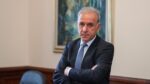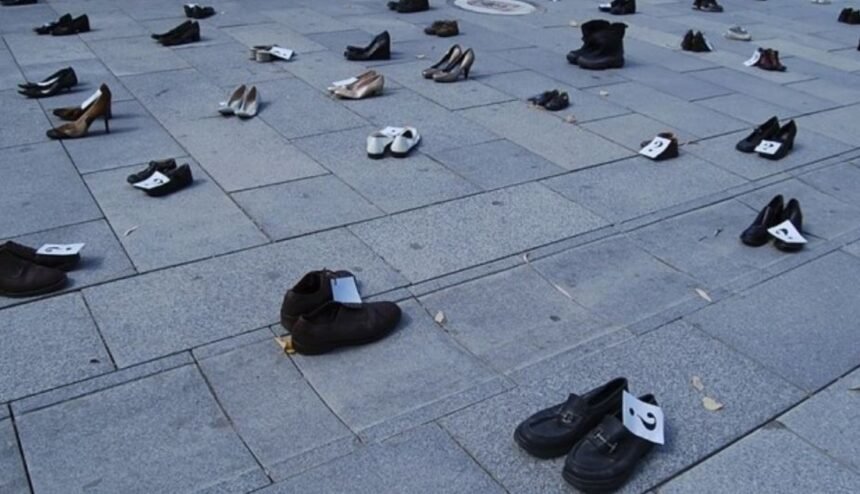
After seven hours of discussion, Kosovo and Serbia agreed on January 22 to operationalize the Commission for Missing Persons during the war in Kosovo. However, Andin Hoti, Chair of Kosovo’s Government Commission for Missing Persons, expressed concern that Serbia might once again refuse to implement the commission or comply with Kosovo’s requests, particularly regarding access to archives.
In an interview with Ekonomia Online, Hoti said that during the meeting, Serbia attempted to weaken the authority of the joint commission and leave it only within working groups or other mechanisms.
He stated that Kosovo’s demands have long been public, especially those related to access to Serbian military archives.
“Our requests have been submitted since January 15 of last year; we repeated them in June and September. Additionally, there are other public requests, such as the letters we sent to Vučić regarding the archives of the 37th Brigade. So our demands are clear and public; I have no reason to hide them. I even shared them on Facebook and through media multiple times. The demands are clear; now it remains to see in the next meeting whether Serbia is willing to implement them, particularly granting access to classified military archives from the war period,” he said.
Regarding Serbia’s stance, Hoti noted that the country has consistently tried to undermine the political authority of the Joint Commission.
“I don’t know what pushed them, but I think they had no other option. What Serbia wanted was to again weaken the political authority of the joint commission, leaving it only within working groups or other mechanisms. Of course, I insisted that this cannot happen because we agreed in December 2024 on the main purpose of coming to Brussels, which has been ongoing for years. Finally, they agreed. I was not present at that meeting; most discussions were conducted through the European Union via Mr. Sorensen, and I don’t know what was discussed between him and Serbia. Ultimately, they gave in, perhaps realizing the request was absurd because there is no need to establish another mechanism when one already exists,” he explained.
Hoti emphasized that the key question is whether Serbia will implement this decision, highlighting the EU’s role.
“Now it remains to see how ready the European Union is to act when faced with Serbian resistance. The joint commission was established, we will continue meetings, and we will reiterate our public demands. But whether Serbia complies will depend on how strongly the EU enforces its role,” he said.
He also described the closed-door meeting in Brussels:
“Based on the terms of reference, even though the deadlines have passed over a year ago, immediately after the commission’s establishment on Thursday—which faced many challenges, as Serbia initially refused—we spent about seven hours in the meeting to finalize this commission. Within a month, the EU is obliged, according to the terms of reference, to call the next meeting and present the demands of both sides,” Hoti stated.
Hoti underlined that his goal, since 2021, was to involve the EU directly in the issue of missing persons, due to Serbia’s unwillingness to cooperate.
“My goal since 2021, when I started going to Brussels, was to involve the EU in the missing persons issue because Serbia was not willing to cooperate, especially regarding archives and other matters. This has been achieved, but work remains. The EU must take its rightful role as chair. According to the terms of reference, if any party fails to cooperate or meet its commitments, the chair must notify all 27 EU member states of Serbia’s non-cooperation. This is crucial. Will the fate of missing persons be resolved? Not by this point alone. Today we have a mechanism and an EU document that should exert stronger pressure on Serbia to provide credible information that we continue to request,” he emphasized.
The January 22 agreement was reached at a trilateral meeting in Brussels, led by EU Special Envoy for the Dialogue, Peter Sorensen.