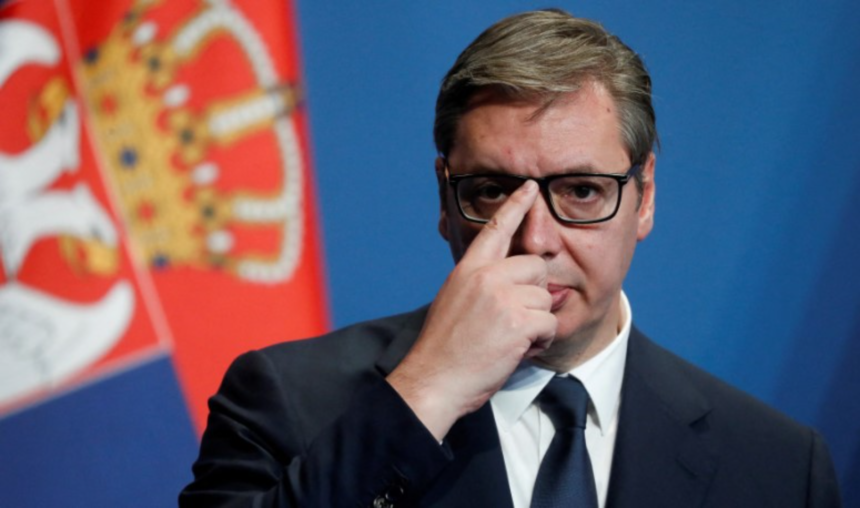
Serbian President Aleksandar Vučić has denied any state involvement in the seizure of five tonnes of marijuana, discovered on property linked to a local official of the ruling Serbian Progressive Party (SNS), despite mounting questions from the opposition regarding political responsibility and institutional oversight.
Speaking to TV Pink, Vučić insisted that the operation was carried out by state authorities themselves, accusing his political opponents of deliberately distorting the facts.
“People from the Criminal Police Directorate found five tonnes of drugs. Whether only the son knew about it, or both the son and the father, is for the competent institutions to determine. I will not speculate. We carried out this action,” Vučić said.
The president claimed that his opponents were attempting to reverse the narrative by suggesting that the state was complicit in the criminal operation.
Largest Drug Seizure in Serbia’s History
On January 29, Serbian police, in cooperation with the Prosecution for Organised Crime, seized five tonnes of marijuana in the village of Konjuh, near Kruševac, marking the largest drug seizure ever recorded in Serbia.
Authorities identified the suspects as Aleksandar Mijajlović, Nebojša Spasojević, Rade Spasojević, Ivan Dragnić, and Uroš Mladenovski.
Mijajlović, alleged to be the organiser of the criminal group, remains at large, with prosecutors seeking both domestic and international arrest warrants.
According to the Prosecution for Organised Crime, the group operated on an international scale, procuring the marijuana in North Macedonia before transporting and storing it in Serbia.
Opposition Raises Political Links
The case has taken on a distinct political dimension after Miroslav Aleksić, leader of the opposition People’s Movement of Serbia, claimed that one of the arrested individuals is an SNS municipal councillor in Kruševac.
Aleksić further alleged that the suspect is a “friend and close associate” of the family of Defence Minister Bratislav Gašić, raising concerns about possible political protection and institutional silence.
While Gašić did not directly respond to these allegations, he issued a statement praising the police operation, saying it demonstrated that “there are no protected individuals in Serbia.”
A similar message was echoed by Nevena Đurić Nikitović, vice-president of the SNS City Committee in Kruševac, who stated that the state is “clear and relentless in its fight against crime and corruption.”
Unanswered Questions
Despite Vučić’s firm denial of state involvement, the scale of the operation, the political affiliation of at least one suspect, and the absence of clear accountability at higher levels have fueled public skepticism.
Critics argue that arresting local actors alone does not address broader concerns about whether criminal networks can operate on such a scale without institutional awareness or protection, particularly in a highly centralised political system.
As investigations continue, the case is increasingly viewed as a test of Serbia’s commitment to the rule of law, especially amid long-standing accusations that law enforcement selectively targets individuals while shielding those close to power.