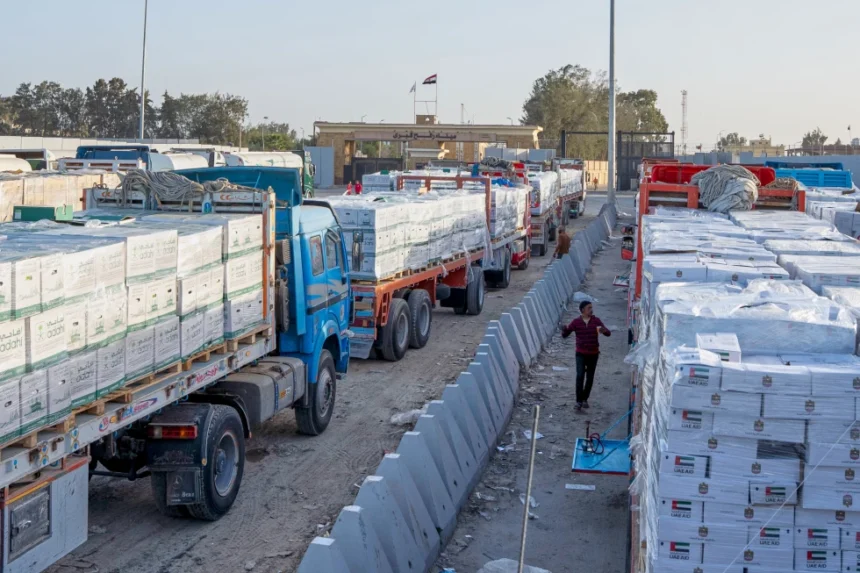
Palestinians in Gaza watched with hope and impatience on Sunday as preparations were finalized to partially reopen the Rafah border crossing with Egypt, the territory’s main gateway to the outside world. Israel announced that limited travel through the crossing will resume on Monday, as the ceasefire with Hamas continues to hold despite recent tensions.
Residents expressed cautious optimism, while voicing concerns over restrictions.
“Opening the crossing is a good step, but the limited number of people allowed to cross is a problem,” said Ghalia Abu Mustafa, a resident of Khan Younis.
Israel confirmed that the crossing had already been opened on a trial basis, with the Israeli military agency overseeing aid stating that residents may begin crossing on Monday, though only a small number will be permitted initially.
“We want it open permanently so sick people can travel and return,” said Suhaila Al-Astal, a displaced woman from Rafah whose daughter requires medical treatment abroad.
Limited Movement at First
The Rafah crossing has been largely closed since Israel seized control of it in May 2024. According to Israeli officials, only dozens of people will be allowed to enter or exit Gaza each day at the start, with no commercial cargo permitted initially.
Prime Minister Benjamin Netanyahu stated that Israel will allow 50 medical patients to leave Gaza daily, each accompanied by two relatives, while 50 Palestinians who left Gaza during the war will be allowed to return each day.
However, Gaza’s Health Ministry said it has not yet been officially notified of the start of medical evacuations.
Israel and Egypt will jointly vet travelers, while the crossing will be supervised by European Union border monitors. Officials said the number of travelers could increase if the system proves effective.
Ceasefire Strained by Recent Violence
Israel’s announcement came one day after Israeli airstrikes killed at least 30 Palestinians, including several children, according to hospital officials — one of the deadliest days since the ceasefire began on October 10. Israel accused Hamas of violating the truce.
Nicolay Mladenov, head of U.S. President Donald Trump’s newly established Gaza peace board, urged all sides to “exercise restraint”, stating that efforts are underway with a new Palestinian oversight committee to prevent further incidents.
Doctors Without Borders Facing Expulsion
On Sunday, Israel’s Diaspora Ministry announced plans to terminate the operations of Doctors Without Borders (MSF) in Gaza by February 28.
Israel previously suspended MSF’s activities in December, citing non-compliance with new registration rules, including requirements to submit lists of local employees. MSF has warned that these regulations could endanger Palestinian staff.
The organization plays a critical role in Gaza’s health system, supporting six hospitals, running two field hospitals, eight clinics, and two child malnutrition stabilization centers. Humanitarian groups have warned that suspending aid operations will severely harm Gaza’s civilian population.
Rafah’s Strategic Importance
Before the war, Rafah was Gaza’s primary crossing for people, while four additional crossings connect the territory with Israel. Palestinian security personnel and ambulances crossed into Gaza on Sunday to prepare for operations alongside EU border agents, according to Egyptian officials.
Under the ceasefire agreement, Israel maintains military control of the buffer zone surrounding Rafah. Egypt has repeatedly stressed that the crossing must remain open in both directions, rejecting any attempt to force Palestinians out of Gaza.
War and Ceasefire Context
The ceasefire halted more than two years of war, which began with a Hamas-led attack on southern Israel on October 7, 2023, killing about 1,200 people and taking 251 hostages.
Israel’s subsequent military campaign has killed 71,795 Palestinians, including 523 since the ceasefire began, according to Gaza’s Health Ministry, figures widely cited by UN agencies and independent experts.
The first phase of the ceasefire included hostage-prisoner exchanges, increased humanitarian aid, and partial Israeli troop withdrawals.
The second phase, still under negotiation, envisions a new governing committee for Gaza, an international security presence, Hamas disarmament, and the start of reconstruction efforts.