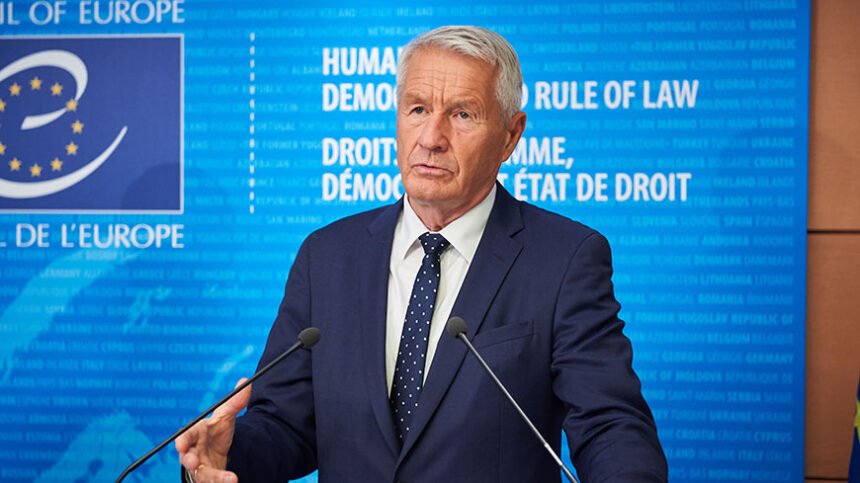
New revelations from the Epstein files linking Thorbjørn Jagland to Russian circles have raised serious questions about his role and influence in the political process that led to the establishment of the Kosovo Specialist Chambers. Jagland, the former Secretary General of the Council of Europe, is described as a key institutional figure in the trajectory that culminated in the creation of the court tasked with prosecuting former leaders of the Kosovo Liberation Army (KLA).
According to published email correspondence, Jagland allegedly acted as an intermediary between Jeffrey Epstein and high-level Russian circles, including efforts to establish contacts with Russian President Vladimir Putin.
Questions of Influence and Conflict of Interest
These documents raise serious concerns about networks of influence and potential conflicts of interest, involving a figure who at the same time headed one of Europe’s most important human rights institutions. The newly revealed links have cast political doubt on Jagland’s impartiality, particularly regarding his influence on Kosovo-related matters.
Russia has historically opposed Kosovo’s independence and has consistently supported Serbia in international forums. In this context, the fact that a central actor in legitimizing the Dick Marty report and in facilitating the creation of the Specialist Court is now alleged to have served as a communication bridge with Russian circles via Epstein raises profound concerns about how the international narrative surrounding the KLA war was shaped, writes Albanian Post.
A History of Controversial Statements
Jagland’s relationship with Kosovo has never been perceived as neutral. As early as 2004, during a conference at the Norwegian School of Economics, he reportedly stated that “Kosovo does not produce much besides crime.” The remark, coming from a former Norwegian prime minister and prominent European political figure, sparked strong reactions at the time.
In 2010, while serving as Secretary General of the Council of Europe, Jagland publicly responded to the report authored by Swiss senator Dick Marty, which alleged that KLA leaders were involved in organ trafficking and inhumane treatment of Serbian prisoners during and after the war.
Jagland stated that the allegations were serious and must either be confirmed or dismissed through a comprehensive international investigation, emphasizing the need to “establish the truth,” despite acknowledging the potential political consequences of the report.
Institutional Legitimization and Long-Term Impact
These statements came from the head of an institution with significant moral and political authority on human rights in Europe. In this role, Jagland provided institutional weight and political legitimacy to the Marty report, a process that eventually led to the establishment of the Kosovo Specialist Chambers.
As a result, former KLA leaders continue to be held in detention, awaiting final rulings from the court.
From a historical perspective, Jagland emerges as a central figure in constructing the legal architecture that placed Kosovo’s liberation war under international investigation.
Political or Purely Legal?
The emerging dilemma is whether Jagland’s approach toward Kosovo was purely legal or also politically motivated.
Russia, as Serbia’s steadfast ally on the international stage, has had a strategic interest in portraying the KLA war as criminal and problematic. If a key European institutional figure is now shown to have maintained close communication links with Russian circles via Epstein, then the question of conflict of interest can no longer be dismissed as mere speculation.