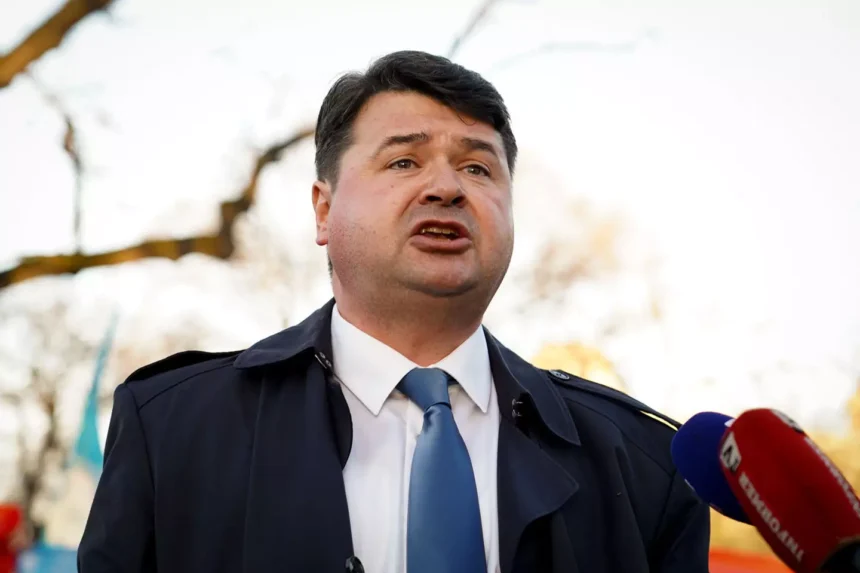
Serbia’s judiciary is facing unprecedented pressure and intimidation after Vladan Petrov, President of the Constitutional Court, openly warned that judges and prosecutors who publicly oppose the current government could be dismissed from office—a move critics say exposes the deep political capture of the country’s legal system.
In an interview with the daily Politika, Petrov stated that judges who violate the ban on political activity and “publicly declare themselves opponents of the current власти” should face dismissal, despite widespread legal consensus that judges retain the right to express opinions on matters beyond the judiciary.
The remarks come amid growing unrest within the legal community over the recently adopted so-called “Mrdić Laws,” which critics describe as tailor-made to protect organized crime networks and close allies of President Aleksandar Vučić currently facing prosecution.
Judicial Strike Sparks Fear Inside the Regime
According to Nemanja Đurić, President of the Judicial Authority Trade Union, Petrov’s statements reflect panic within the ruling establishment as judges and prosecutors launch mass work stoppages across Serbia, an action without precedent in the country’s history.
“These laws favor the mafia and Vučić’s closest associates,” Đurić said, warning that the legislation could lead to the effective dismantling of the Prosecutor’s Office for Organized Crime and the collapse of judicial independence altogether.
Work stoppages began on Monday in dozens of cities, marking the first coordinated judicial strike in Serbia’s modern history. Đurić argues that Petrov’s threats were designed to intimidate and demobilize judges and prosecutors before resistance spreads further.
Lavish Praise for Vučić Raises Conflict of Interest Concerns
Petrov’s credibility has been further undermined by his open admiration for President Vučić, whom he has repeatedly praised in media appearances. In an interview with TV Prva, Petrov described Vučić’s TikTok presence as evidence of “serious personal charisma” and marveled at the president’s ability to “evolve rapidly” and dominate public attention.
“You need exceptional personal charisma to do this,” Petrov said, adding that he was unconcerned about being labeled a Vučić supporter.
Critics argue that such overt political favoritism from the head of the Constitutional Court disqualifies Petrov from acting as an impartial guardian of the Constitution.
Legal Experts: Petrov Has No Authority to Dismiss Judges
Đurić stressed that Petrov has no legal authority to dismiss judges or prosecutors, noting that such decisions rest exclusively with the High Judicial Council (VSS) and the High Prosecutorial Council (VST).
He also pointed out that European Court of Human Rights jurisprudence and EU standards explicitly protect judges’ freedom of expression, a position even acknowledged by Serbia’s own High Judicial Council.
“Petrov, like his political idol, does not seem to understand the limits of his own authority,” Đurić said.
Escalating Institutional Pressure
Despite denying that he was issuing threats, Petrov has intensified what observers describe as a media and institutional offensive, publicly urging the VST to repeat disputed elections for its members and warning that the Serbian government would enforce Constitutional Court decisions if prosecutors failed to comply.
He insisted that such enforcement mechanisms were “not threats”, even as critics interpreted the statements as direct political pressure on independent institutions.
‘Ready to Resign’—But on His Own Terms
Petrov claimed he would be “ready to resign” if a joint session of judicial councils determined he had engaged in political activity—while simultaneously defending the constitutionality of the controversial Mrdić Laws and downplaying procedural violations, including the failure to consult the Venice Commission.
Even if the Venice Commission were to criticize the laws, Petrov argued, their constitutionality would remain intact—a statement that has further alarmed legal experts.
“Such threats would not exist if the situation were not extremely unfavorable for the authorities,” Đurić concluded. “Fear is driving intimidation.”